1. Definitions of GPON Stick vs. Standard ONT
1.1 What Is a GPON Stick (SFP stick)?
A GPON Stick is a pluggable GPON ONU/ONT built in an SFP form factor—often marketed as an SFP stick, GPON SFP ONU, or simply a GPON stick. Instead of installing a standalone fiber ONT with a separate power adapter and Ethernet patch cord, you insert the module into an SFP port on a router, switch, firewall, or industrial gateway. The module terminates the GPON optical link and hands off Ethernet to the host device, allowing your existing networking equipment to act as the customer-side demarcation point. This approach is commonly positioned as a compact, rack-friendly way to deliver GPON to edge sites, cabinets, or enterprise networks where space, cabling simplicity, and power efficiency matter.
.jpg "/uploads/image/2026/04/09/What Is a GPON Stick (SFP stick).jpg")
1.2 What Is a Standard ONT?
A standard ONT, sometimes called a standalone ONU/ONT or a fiber modem, is a dedicated external CPE device that terminates the GPON fiber link and presents one or more Ethernet interfaces to the customer network. Unlike a GPON stick or SFP stick that plugs into an SFP cage, a standard ONT is a self-powered appliance that is typically designed for broad OLT interoperability, consistent OMCI provisioning, and straightforward field troubleshooting because the ports and status LEDs are easy to access and replacements are usually handled by swapping the unit, re-provisioning it, and restoring service.
2. GPON Stick vs. Standard ONT - 3 Key Differences That Matter
2.1 Performance: GPON stick / SFP stick vs standard ONT
Network performance in a GPON access design is often misunderstood as purely a PON line-rate question. In reality, GPON performance at a site is the sum of multiple constraints: the shared PON capacity on the splitter, the UNI handoff speed, and the forwarding path that processes frames once they leave the GPON side. This is why two endpoints on the same OLT can show different results in speed tests, latency under load, or burst behavior. With a GPON stick, an SFP stick ONU/ONT, the UNI handoff is created through the host device’s SFP interface and datapath. That makes the host router/switch a first-class performance variable: its SFP cage implementation, switching/CPU architecture, VLAN/QoS configuration, and even its firmware can influence throughput consistency and buffer behavior. In a well-designed setup—especially when the stick is used in bridge mode and the host device has strong hardware forwarding—the result can be extremely clean, with fewer extra boxes in the chain.
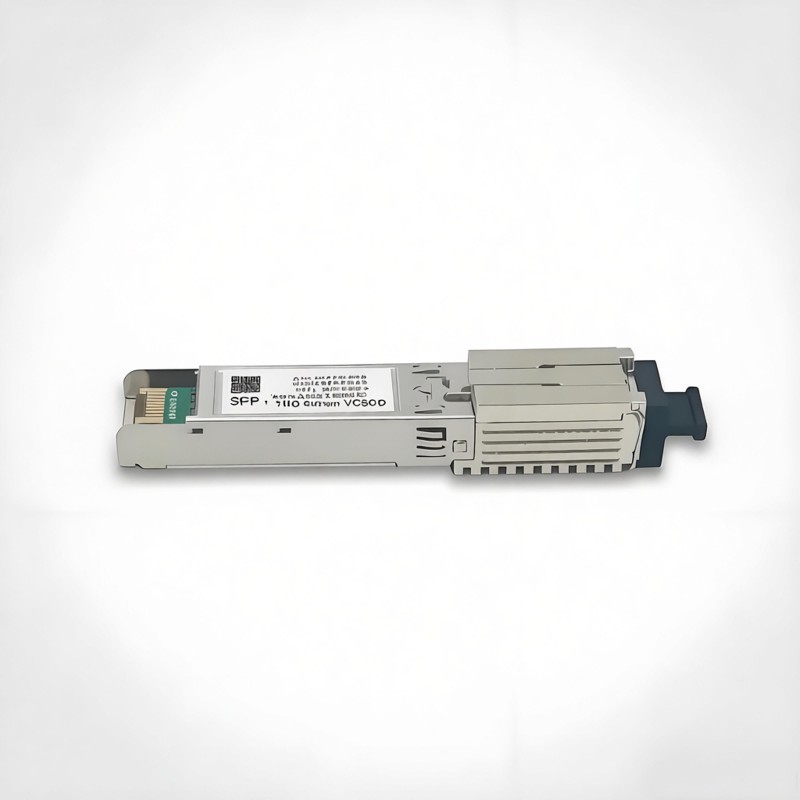
A standard ONT, by contrast, is built as a self-contained access appliance. Even when it is placed into bridge mode, its internal design is dedicated to GPON termination plus Ethernet delivery, so performance characteristics are generally more predictable across different customer sites because the host platform is the ONT itself. That predictability can matter more than peak throughput when you operate many endpoints and need consistent user experience. Finally, there is a practical ceiling question: many deployments are effectively limited by 1GbE on the customer side, regardless of the PON’s aggregate capacity. Some GPON sticks on the market emphasize higher-speed electrical handoff. For example, 2.5GbE variants, but your real limit still depends on the stick model and whether your host equipment can negotiate and forward at that speed without becoming the bottleneck.
| Item | GPON Stick (SFP stick) | Standard ONT |
| PON-side capacity | Same GPON PON limits | Same GPON PON limits |
| UNI handoff | Depends on stick + host SFP/forwarding | Defined by ONT hardware (often 1G, multi-LAN common) |
| Key performance variable | Host device datapath and config | ONT internal design and mode (bridge/router) |
| Best-fit performance goal | Bridge into a strong router/firewall | Predictable CPE performance at scale |
2.2 Compatibility & provisioning: GPON Stick vs Standard ONT
In production GPON networks, compatibility is often the biggest determinant of performance, because an endpoint that cannot consistently register, stay authorized, and accept configuration will never deliver stable throughput or latency. Even when devices claim standards compliance, GPON interoperability still depends on real OLT behaviors, OMCI expectations, and the operator’s provisioning templates. A major advantage of the standard ONT is that it aligns with common ISP workflows by supporting authentication methods such as serial number or LOID, enabling OMCI profile assignment, and fitting predictable remote management patterns. Because standard ONTs are widely deployed, operators often maintain validated device models and firmware baselines that are known to work correctly with specific OLT line cards and service profiles, which reduces uncertainty during rollout and helps minimize edge-case failures. A GPON stick / SFP stick can absolutely be interoperable, but it tends to be more sensitive to the exact OLT environment and ISP-side policy. Many stick products are positioned for compact deployments and flexibility, yet sellers frequently emphasize that compatibility cannot be guaranteed without access to the target OLT and provisioning system—because the stick must match OMCI behavior and authorization methods used by the operator.
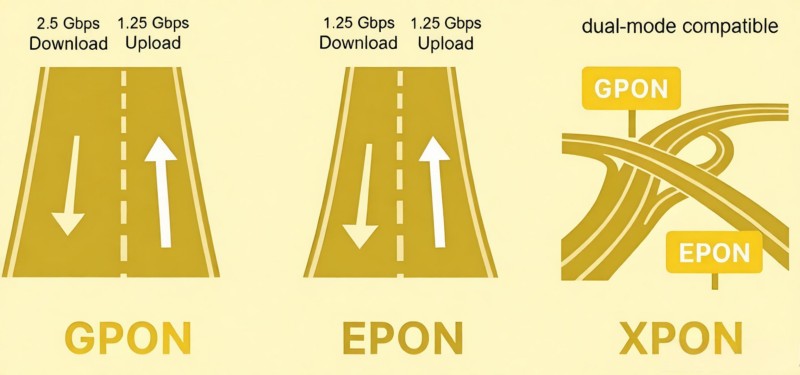
Compatibility decisions are further complicated by multi-mode marketing such as XPON, which supports GPON and EPON in a single unit. This can simplify inventory planning and mixed-environment strategies, but it does not remove the need for OLT-side validation, because the best-performing endpoint is still the one your OLT can provision cleanly, that supports the required service profiles such as VLANs, QoS, and IPTV or IGMP, and that remains stable across firmware updates and ongoing operational changes.
2.3 Reliability & operations: GPON Stick vs Standard ONT
Reliability is performance over time, and that includes environmental stability, fault isolation speed, and mean time to restore service. A standard ONT is physically separate, has its own enclosure and power, and is typically designed for continuous operation in customer premises conditions. That separation also makes it simpler for many field teams: link lights, port access, and replacement procedures are obvious, which reduces time-to-diagnose and time-to-repair. An SFP stick concentrates the ONT function into a module that depends on the host device’s environment. In a well-cooled rack, this can be a major operational win: fewer power bricks, fewer Ethernet patch cords, and a cleaner cabinet. But in tight spaces or fanless appliances, the SFP cage can become a thermal hotspot; if a module resets or behaves intermittently due to heat, the symptoms may look like random performance drops rather than a clear hardware fault. Operations also differ in troubleshooting workflow. With a standard ONT, technicians can often isolate issues quickly by checking optical power indicators/alarms on the ONT, swapping patch cords, and replacing the box if needed. With a GPON stick, isolation may require verifying the host SFP port, host configuration, and module health—meaning a networking team may need to get involved rather than a typical CPE swap process. Finally, consider lifecycle operations: firmware alignment, monitoring, and inventory planning. A GPON stick can be extremely reliable in a controlled enterprise environment where the same host platforms are deployed consistently and monitoring is centralized. Standard ONTs tend to be more forgiving across varied real-world customer environments and heterogeneous home/SMB setups, which is why they remain the default option for mass-market access.
3. How to Choose: GPON Stick vs Standard ONT
If your priority is cabinet density, cleaner cabling, and integrating GPON directly into an existing router or switch datapath, a GPON stick is often the better fit—as long as you validate OLT compatibility, OMCI behavior, and the thermal/power characteristics of the host device in conditions that match production. This choice is especially compelling in enterprise edge deployments, Passive Optical LAN designs, controlled rack environments, and scenarios where you want a pure bridge handoff into your own firewall/router without adding another powered box. If your priority is predictable interoperability, repeatable provisioning at scale, and fast field service with minimal integration risk, a standard ONT is usually the safer and more operationally efficient option. It’s the default for many FTTH/FTTB rollouts precisely because it fits established ISP processes and reduces the number of host-dependent variables that can impact performance and stability over the device lifecycle. A practical pre-buy checklist for either option is to confirm the target OLT vendor and model, verify the required authentication method such as serial number or LOID, define the service profiles you must deliver including VLAN, QoS, and IPTV, make sure the UNI speed matches your needs whether that is 1G or 2.5G, calculate the optical budget based on distance and split ratio, and evaluate environmental constraints—paying particular attention to SFP cage temperature when you plan to deploy a GPON stick or SFP stick.
By Lanaotek
Lanaotek specializes in translating cutting-edge optical and Ethernet transmission technologies into clear, valuable insights that help our customers stay ahead in a fast-evolving digital world.
By turning complex technical concepts into practical, business-driven content, we aim to empower decision-makers with the knowledge they need to make confident, future-ready choices.
 EN
EN
 fr
fr  es
es  ru
ru  pt
pt  ar
ar  de
de 
 Internet Data Center
 FAQs
FAQs Industry News
 About Us
 Data Center Switch
  Enterprise Switch
  Industrial Switch
  Access Switch
  Integrated Network
  Optical Module & Cable



 Call us on:
  Email Us:
  2106B, #3D, Cloud Park Phase 1, Bantian, Longgang, Shenzhen, 518129, P.R.C.