In 2011, Magyar Telekom launched the IPTV project to provide live video, video-on-demand (VOD), and time-shifted services for its broadband users, so as to enhance user experience and reduce broadband user churn.
The IPTV network architecture mainly consists of three parts: headend equipment, network transmission, and terminal equipment.
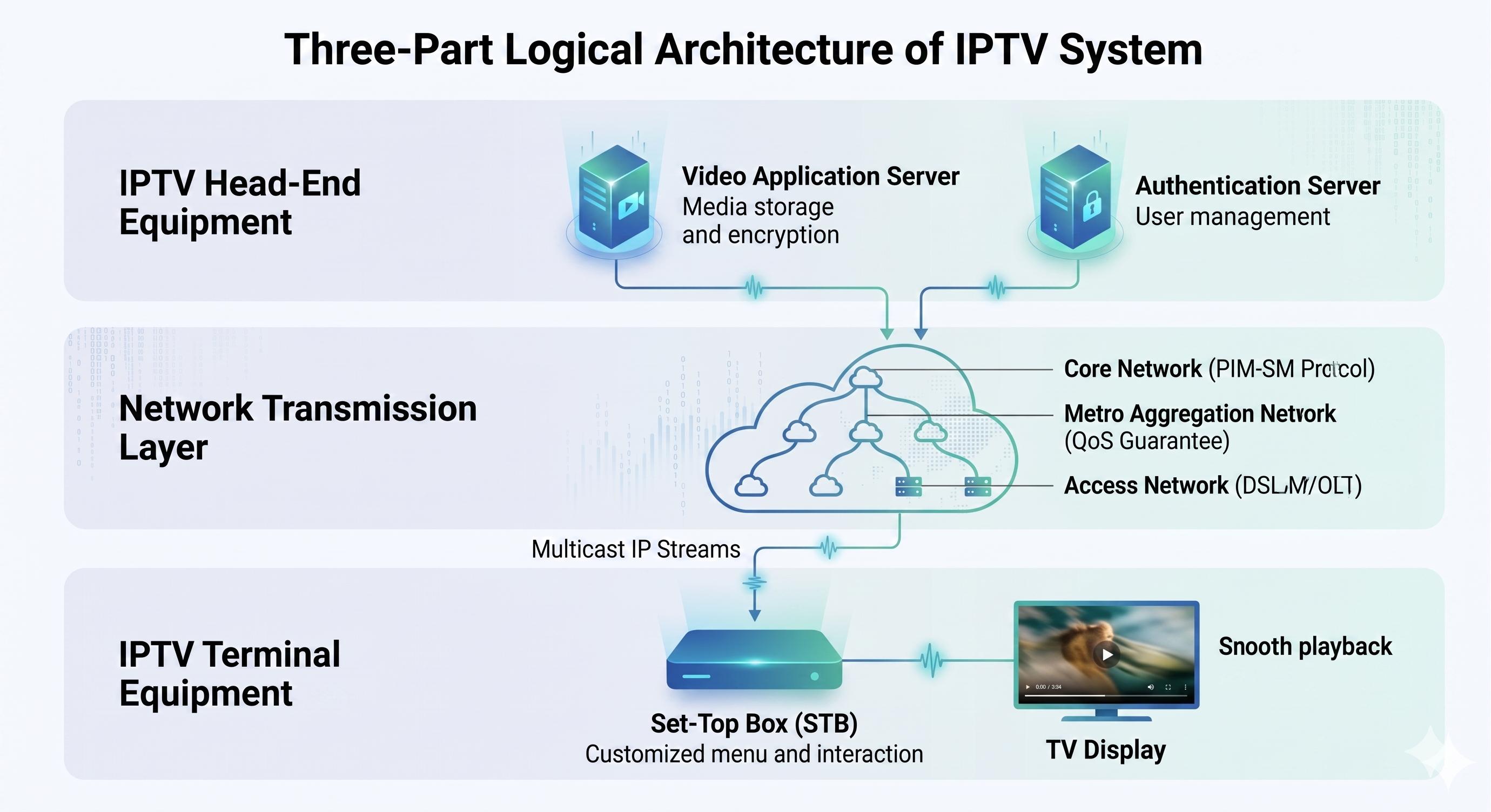
The IPTV headend equipment is usually a dedicated video server, which is responsible for storing and pushing encrypted audio and video streams, and supports user authentication at the same time. The network transmission part of IPTV transmits video streams from servers to user terminals through IP multicast technology. Terminal equipment of IPTV, such as set-top boxes (STBs), is used to receive, store and play video content.
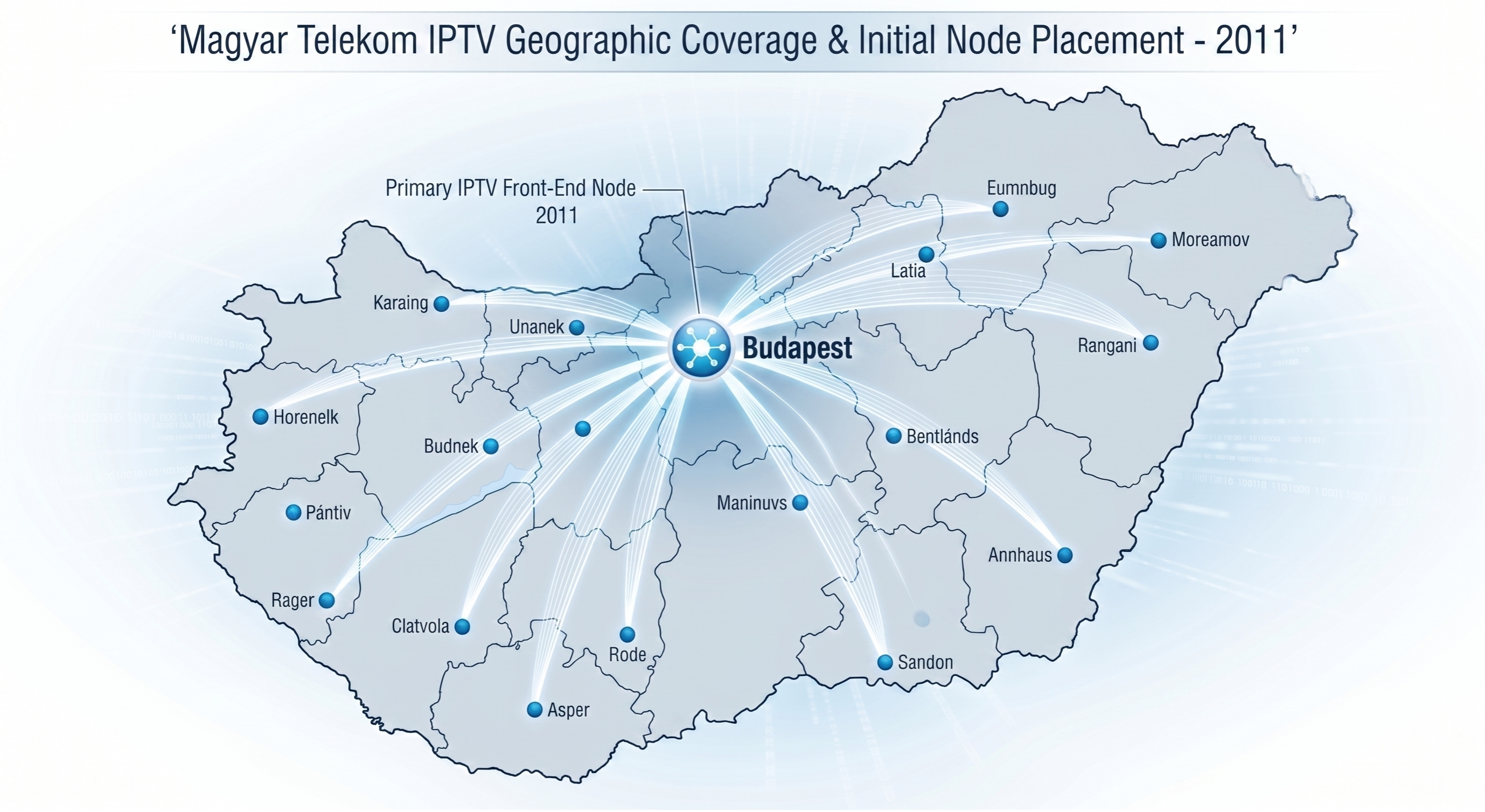
The number of headend equipment sites and the equipment capacity of each site are determined by the geographical distribution and quantity of end users to be covered. Magyar Telekom's fixed broadband network covers all 20 cities in Hungary, with approximately 4 million broadband users. Budapest, the capital city, is located north of the center of Hungary, and the other 19 cities are distributed in a fan shape around the capital, with no city excessively far from Budapest. Given the geographical distribution of Magyar Telekom's broadband users, it is only necessary to build one headend equipment site in Budapest in the initial phase. In the later stage, the need to construct secondary headend equipment sites can be determined according to the IPTV experience of broadband users in the other 19 cities. After joint discussions with the construction and marketing departments of Magyar Telekom, it was confirmed that the initial headend equipment capacity shall be built for 200,000 IPTV users, 300 channels, 50,000 movies and 100,000 TV drama episodes.
The IPTV terminal equipment (STB) needs customized boot-up interface, menu and interaction as required by Magyar Telekom. The terminal equipment (STB) shall meet the basic performance requirements of IPTV services:
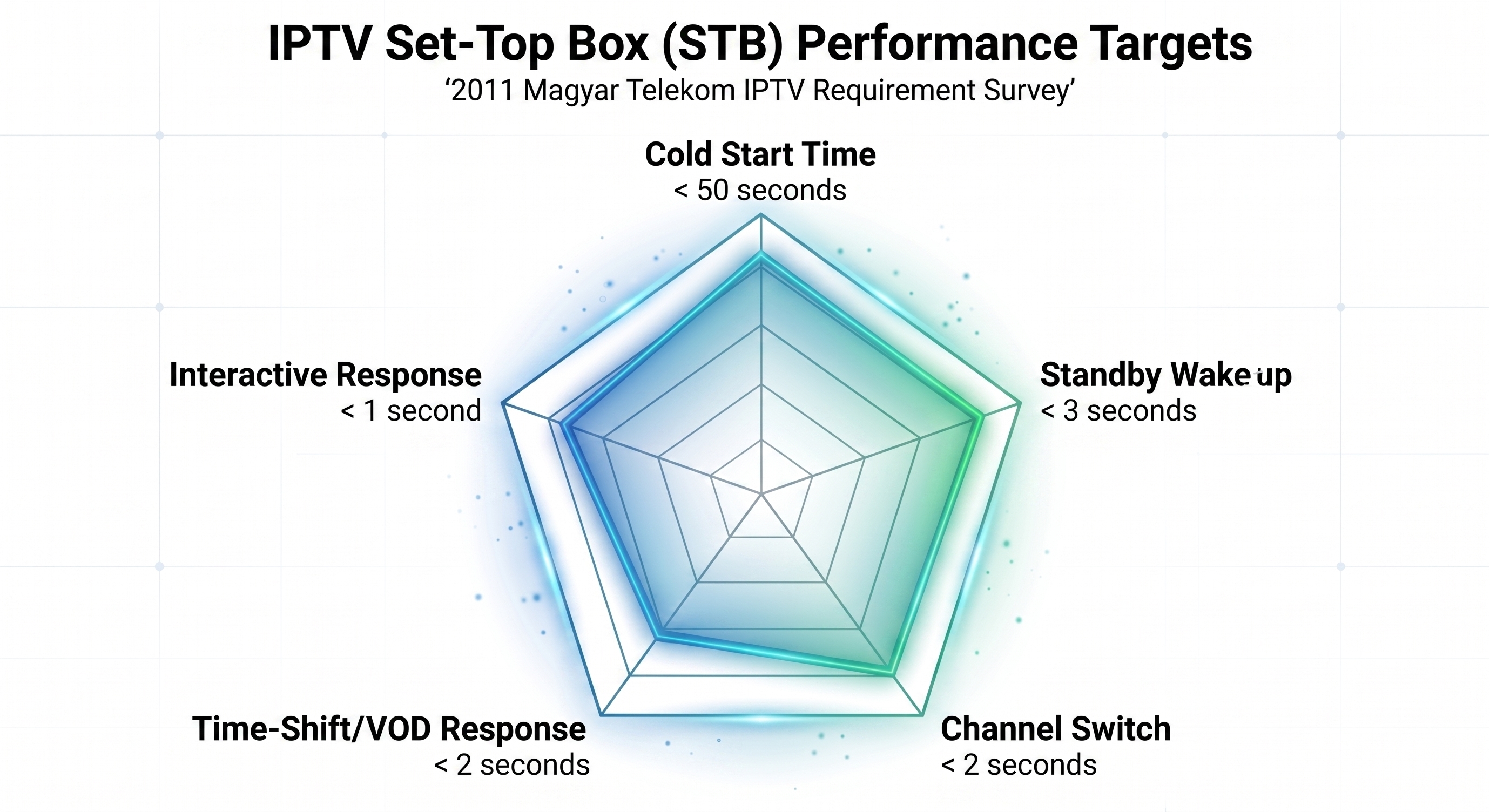
Cold start ≤ 50 seconds;
Standby wake-up ≤ 3 seconds;
Channel switching ≤ 2 seconds;
Response time of time-shifted, catch-up and VOD services ≤ 2 seconds;
Interactive operation response ≤ 1 second.
The first batch of terminal equipment is 50,000 units, to be delivered in batches.
To properly support IPTV services, the network transmission part shall meet the following technical requirements:
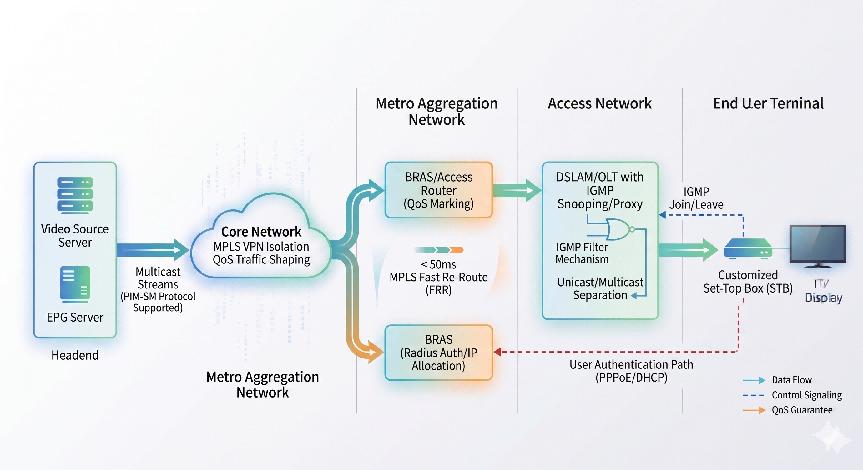
1. The bearer network must have QoS capability to provide QoS guarantee for IPTV services and meet the service requirements for network performance parameters such as bandwidth, delay and jitter.
2. The bearer network must have high security.
3. The bearer network must support MPLS forwarding and MPLS VPN to realize VPN isolation for IPTV.
4. The bearer network needs to support service identification, and realize service identification at the edge layer for traffic classification, scheduling and shaping, so as to perform different processing.
5. To reduce network fault recovery time, the backbone and metro parts of the bearer layer network shall support fast route convergence, MPLS fast reroute and other functions, with a fault switching time of less than 50ms.
6. The network must support identity authentication for IPTV users and assign a legal address to authenticated users to provide various IPTV services.
7. For authenticated users, the function of authority control over their STB terminals shall be supported. Authority control includes access control to multicast streams and control that STBs can only access specific address segments. User multicast authority control can be realized through the IGMP filter mechanism, while STB access control to specific address segments can be realized through route restriction.
8. The network shall be capable of smooth transition to IPv6 support.
9. For multicast services, the backbone network and metro network must provide multicast support, support multicast routing protocols, and have controllable multicast capabilities such as multicast management, multicast security control and static multicast configuration. It shall support separate unicast and multicast, fast channel switching and multicast QoS guarantee. 10. The backbone network shall support the PIM-SM multicast routing protocol (if cross-domain IPTV services are implemented, it shall also support cross-domain multicast, including MP-BGP and MSDP protocols); the metro network shall support the PIM-SM multicast routing protocol and IGMP group member management protocol; access network equipment shall support IGMP Snooping/Proxy to realize controllable multicast.
10. The network supports access modes including ADSL/ADSL2+/VDSL (PPPoE/leased line), LAN (PPPoE/DHCP/leased line), WLAN, FTTH and HFC. Bearering IPTV services over ISDN, narrowband dial-up and other access modes is not considered.
11. It supports Layer 2 link access and aggregation functions, including aggregating IP DSLAM, ATM DSLAM and OLT to BRAS or access routers.
12. The bearer network shall support both single-edge and multi-edge modes. In single-edge mode, access equipment relies on a single edge device to provide all types of services. In multi-edge mode, access equipment shall be able to distinguish and carry different services and interconnect with multiple service edge devices deployed in the network.
13. The access layer shall have QoS capability to ensure service access QoS.
The technical department of Magyar Telekom is fully confident in its bearer network, believing that its bearer network can fully meet the above technical requirements. Therefore, it rejected our proposal for bearer network evaluation and asked us to focus on the construction of IPTV headend equipment sites and customization of IPTV terminal equipment, while the network transmission part of IPTV will be their responsibility.
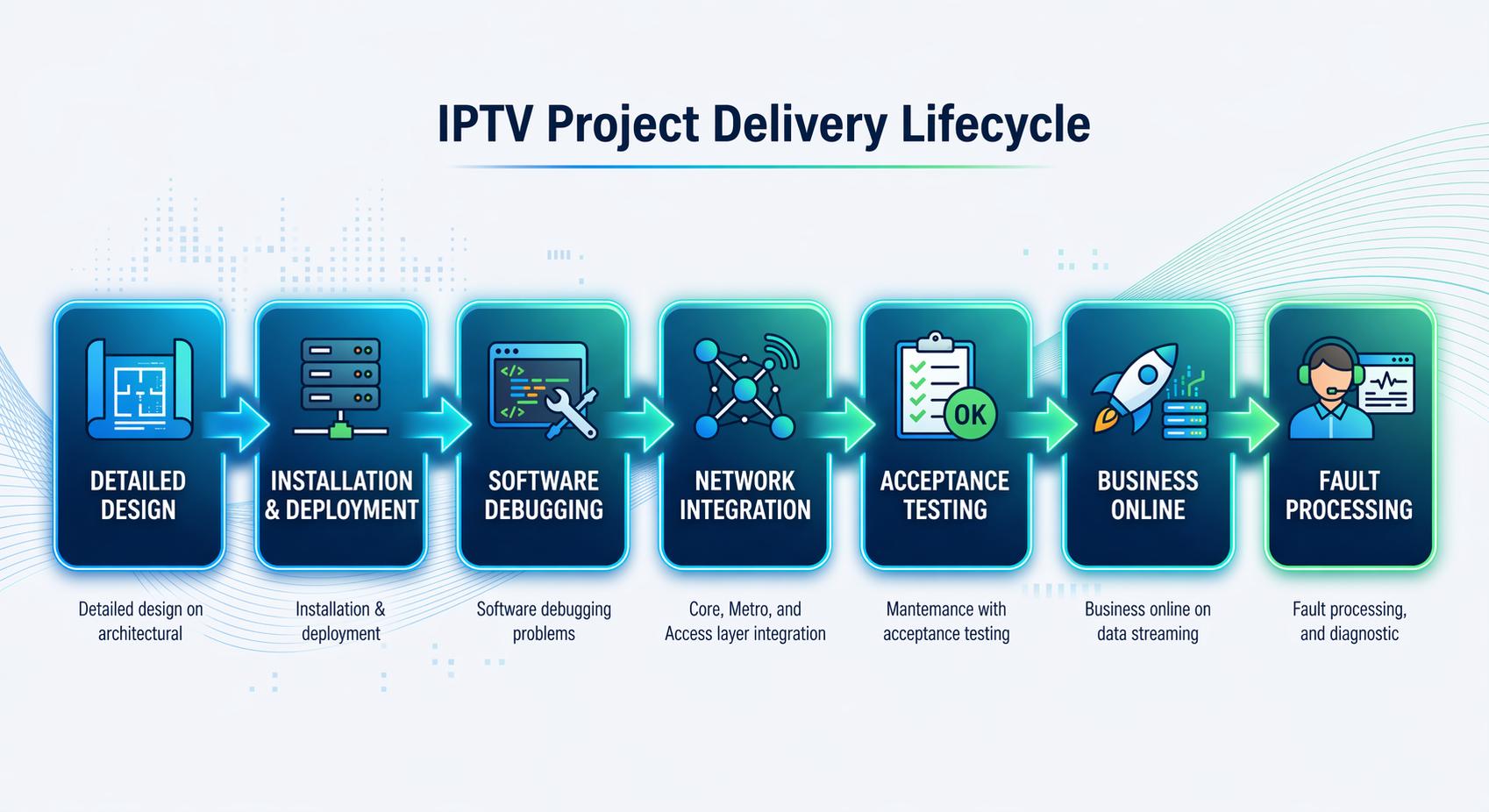
The above clarifies the requirements of Magyar Telekom's IPTV project on headend equipment, network transmission and terminal equipment. Next, a delivery team for the Magyar Telekom IPTV project will be formed to carry out project delivery in accordance with the processes of detailed design, installation and deployment, software commissioning, network integration, acceptance testing, service launch and fault handling.
By Lanaotek
Lanaotek specializes in translating cutting-edge optical and Ethernet transmission technologies into clear, valuable insights that help our customers stay ahead in a fast-evolving digital world.
By turning complex technical concepts into practical, business-driven content, we aim to empower decision-makers with the knowledge they need to make confident, future-ready choices.
 EN
EN
 fr
fr  es
es  ru
ru  pt
pt  ar
ar  de
de 
 Internet Data Center
 FAQs
FAQs Industry News
 About Us
 Data Center Switch
  Enterprise Switch
  Industrial Switch
  Access Switch
  Integrated Network
  Optical Module & Cable

.webp "Choosing Between L2+ and Layer 3 Managed Switches for Enterprise Networks: 2026 B2B Procurement Guide")
 Call us on:
  Email Us:
  2106B, #3D, Cloud Park Phase 1, Bantian, Longgang, Shenzhen, 518129, P.R.C.