Remote security cameras fail in two predictable ways. The first is power: insufficient solar panels, undersized batteries, or inadequate weather protection. The second is the network: the camera is online but cannot transmit video because of cellular drops, unreachable NVRs, or uplink failures.
The most reliable off-grid surveillance deployments treat both systems with equal engineering rigor. This guide covers the complete power architecture and the industrial Ethernet switching layer required to keep cameras connected and protected.
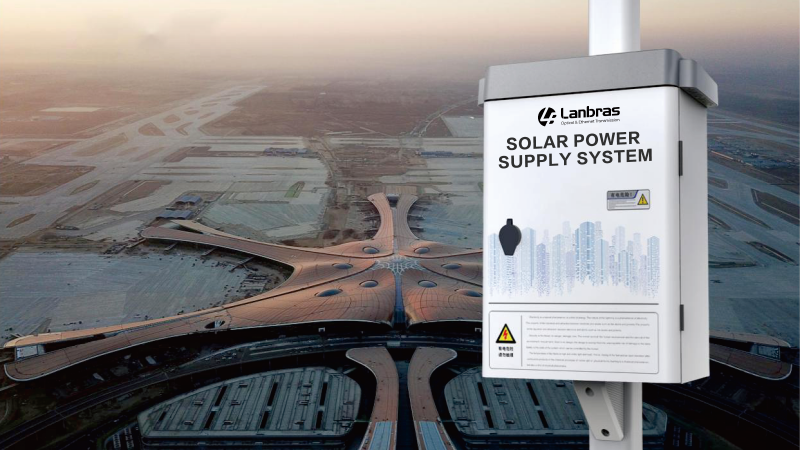
2. Part A — The Power System: Designing Solar Power That Actually Works
2.1 Calculate the Real Daily Energy Load
The foundation of a reliable system is accurate energy accounting. You must include every device in the system, not just the cameras.
| Subsystem | Typical Power (W) | Hours/Day | Daily Energy (Wh) | Planning Notes |
|---|
| IP Security Camera | 8 – 15 | 24 | 192 – 360 | Higher with IR on and AI analytics |
| Cellular 4G/5G Router | 6 – 15 | 24 | 144 – 360 | Often the largest continuous load |
| Industrial PoE Switch | 8 – 12 | 24 | 192 – 288 | Includes switch electronics draw |
| IR Illuminator/Spotlight | 5 – 20 | 8 – 12 | 40 – 240 | Reduce by motion-triggering |
| NVR / Edge Storage | 5 – 15 | 24 | 120 – 360 | Includes write and overhead |
| System Losses | n/a | n/a | +10–20% | DC-DC conversion and cabling |
2.2 Battery Autonomy Sizing
Battery capacity determines how many days the system operates without solar input.
Formula: Battery Capacity (Wh) = (Daily Load × Autonomy Days) ÷ (DoD × Efficiency)
2.3 Solar Panel Sizing
Solar panels must cover the daily load and replenish the battery after a depletion event. Always size for the worst month of the year (winter) at your specific latitude to avoid total system failure in January or February.
2.4 Hardening for Longevity
Enclosure: IP66 or higher, powder-coated steel or UV-stable polymer.
Thermal: Use heat sinks or ventilation; insulate LiFePO4 batteries in climates below 0°C.
Surge Protection: Category B or C SPD on solar inputs and Ethernet/PoE lines.
Low-Voltage Disconnect (LVD): Mandatory to prevent permanent battery damage.
3. Part B — The Network System: Industrial Ethernet and PoE
3.1 The Off-Grid IP Camera Network Stack
| Network Layer | Devices | Lanaotek Product | Function |
|---|
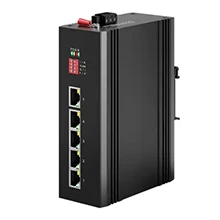
| Device Level | IP Cameras, Sensors | IDSL3LR-02S08GHP-S | PoE power + data aggregation |
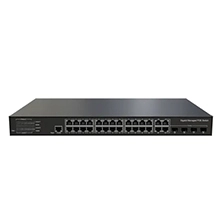
| Local Cluster | NVR, Cellular Gateway | IRSL3LM-04X24GP-2D-Z8 | Local backbone & aggregation |
| Backhaul | 4G/5G/Satellite | SFP+ Uplinks | Connection to remote NOC |
| NOC / Cloud | VMS Server, Storage | LanaotekView NMS | Centralized management |
3.2 PoE vs DC Power
PoE+ (IEEE 802.3at) is the default choice for off-grid surveillance because it combines data and power over one Cat5e/Cat6 cable, reducing labor and complexity.
| Factor | PoE+ (IEEE 802.3at) | 12V/24V DC Direct |
|---|
| Max Power | 30W (up to 90W on PoE++) | Device-dependent |
| Cable Type | Cat5e/Cat6 (Power + Data) | Separate power cable needed |
| Max Distance | 100m (500m with extenders) | Limited by voltage drop |
| Management | Remote Reboot/Load Shedding | Manual / None |
| Diagnostics | Native SNMP status | Manual measurement |
3.3 Network Redundancy: Preventing Isolation
A single uplink is a single point of failure.
Uplink Redundancy: Use dual-SIM cellular routers with automatic failover or hybrid Cellular/VSAT.
Local Ring Redundancy: Use ERPS (G.8032). The Lanaotek IRSL3LM-04X24GP-2D-Z8 supports sub-50ms failover, ensuring cameras stay connected even if a cable is severed.
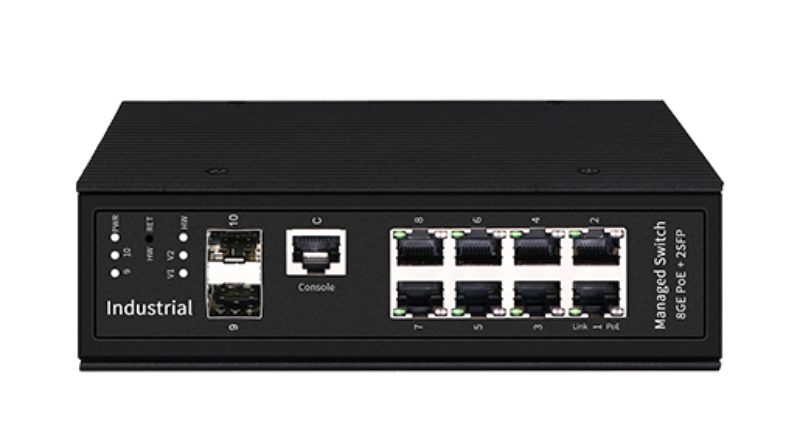
4. Integrating Power and Network: The Master Equation
The power and network systems are one load. Modern systems utilize "Energy-Aware" networking:
PoE Load Shedding: During low-battery events, use SNMP to shut down non-critical cameras (e.g., parking lot) to preserve power for high-priority perimeter feeds.
Scheduling: Configure NVRs to record at lower bitrates during extended cloudy stretches to reduce cellular data and CPU power draw.
5. Deployment, Commissioning, and Operations
5.1 Pre-Deployment Checklist
5.2 The Remote Operations Advantage
Every site visit is a major expense. Use the switch’s SNMP/v3 capabilities to:
Monitor PoE power draw (detecting hardware failure or water ingress).
Check temperature sensors inside the enclosure.
Perform remote power cycles on frozen cameras.
6. Why Lanaotek for Off-Grid Surveillance Networks?
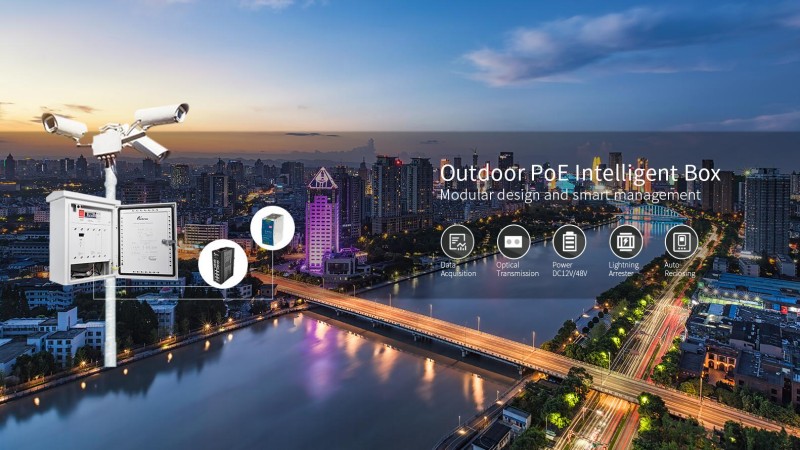
The Lanaotek IDSL3LR-02S08GHP-S industrial 8-port PoE+ managed switch is purpose-built for these environments.
| Feature | IDSL3LR-02S08GHP-S Specification |
|---|
| PoE Ports | 8x GE PoE+ (IEEE 802.3at), 130W total budget |
| Operating Temp | -40°C to 75°C (Extreme durability) |
| Uplinks | 2x SFP+ 10G ports for fiber/backhaul |
| Ring Protection | ERPS G.8032 (<50ms failover) |
| Management | SNMP v2c/v3, CLI, LanaotekView NMS |
| Protection | IP30 Ingress Protection, Industrial Grade |
Ready to Design Your Off-Grid Surveillance Network?
Keywords: off-grid surveillance, solar power for cameras, industrial PoE switch, smart solar box, IP camera network, PoE+ switch, industrial Ethernet switch, Lanaotek IDSL3LR-02S08GHP-S, ERPS ring protection.
By Lanaotek
Lanaotek specializes in translating cutting-edge optical and Ethernet transmission technologies into clear, valuable insights that help our customers stay ahead in a fast-evolving digital world.
By turning complex technical concepts into practical, business-driven content, we aim to empower decision-makers with the knowledge they need to make confident, future-ready choices.
 EN
EN
 fr
fr  es
es  ru
ru  pt
pt  ar
ar  de
de 
 Internet Data Center
 FAQs
FAQs Industry News
 About Us
 Data Center Switch
  Enterprise Switch
  Industrial Switch
  Access Switch
  Integrated Network
  Optical Module & Cable

 Call us on:
  Email Us:
  2106B, #3D, Cloud Park Phase 1, Bantian, Longgang, Shenzhen, 518129, P.R.C.