1. Why the Communication Layer Is the Missing Piece in Smart Pole Retrofits
Every smart city retrofit conversation starts the same way: how do we add sensors, cameras, and digital services to existing light poles without costly construction? By 2026, most municipal teams can answer that question confidently. But the question that still derails deployments is simpler and less glamorous: how do all those devices talk back to the network operations center — reliably, securely, at scale? The communication layer is the most underestimated component of any smart pole retrofit. A CCTV camera that drops frames every 30 seconds is worse than no camera at all. An air quality sensor that sends corrupted data due to electromagnetic interference on the RS-485 bus produces false analytics. And a pole gateway that goes offline after a power surge — because its power input wasn't hardened — creates an island of darkness in your monitoring dashboard. In 2026, the engineering teams that get smart pole retrofits right are the ones that design the network first and the payloads second. This guide is about that network: the industrial Ethernet, PoE, and fiber backhaul infrastructure that makes a smart pole not just smart, but reliable.

2. The Smart Pole Communication Architecture: Three Tiers That Must All Work
2.1 Tier 1 — The Pole-Top Network: PoE as the Unified Power and Data Bus
The most elegant approach to smart pole device integration in 2026 is IEEE 802.3at PoE+ (30W) or IEEE 802.3bt PoE++ (60W/90W) Power over Ethernet. PoE does two things simultaneously: it delivers power and data over a single Cat5e/Cat6 cable to every pole-top device. This eliminates the need for separate power runs to each device, dramatically simplifying installation in existing poles where enclosure space and electrical capacity are both constrained. A typical Class B or Class C smart pole (see Section 3 for pole classification) might draw from its pole-top PoE switch:
One 802.3at PoE+ port for an IP CCTV camera (typically 10-15W per camera)
One 802.3at PoE+ port for a Wi-Fi 6 or Wi-Fi 7 AP (typically 20-25W)· One 802.3bt PoE++ port for a digital signage display or EV charger controller (up to 60W)
One 802.3at PoE+ port for an environmental sensor gateway (typically 5-10W)
One PoE port reserved for the edge gateway itself
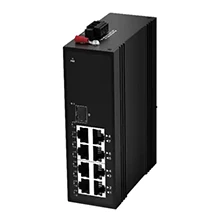
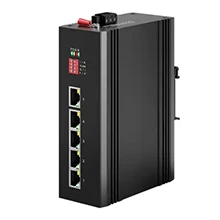
The Lanaotek IDSL3LR-02S08GHP-S industrial 8-port PoE+ managed switch is purpose-built for pole-top deployments: -40°C to 75°C operating temperature, IP30 ingress protection, DIN-rail or wall-mount form factor, and 130W total PoE budget (sufficient for 8 PoE+ devices at full draw). Its compact aluminum housing fits inside standard pole enclosures without requiring structural modification.
2.2 Tier 2 — The Field Aggregation: Industrial Ethernet at the Cabinet
Individual pole-top switches aggregate to a field aggregation switch located in the pole base cabinet or a nearby utility cabinet. This aggregation switch must handle higher port counts (typically 24 to 48 ports per cabinet cluster of 8-16 poles), provide 10G uplinks for fiber backhaul, and support industrial-grade reliability: redundant power inputs, RIP or OSPF dynamic routing for path resilience, and ACL-based network segmentation between smart city zones. For Class B and Class C poles, the Lanaotek IRSL3LM-04X24GP-2D-Z8 industrial L3 managed switch provides 24 Gigabit PoE+ ports plus 4x10G SFP+ uplinks, hardware-based Layer 3 routing, and supports up to 256 VLANs for multi-tenant smart city service isolation. The 10G SFP+ uplinks connect via single-mode or multimode fiber to the nearest fiber Point-of-Presence (POP), eliminating the cost and complexity of running copper Ethernet over long distances between poles.
2.3 Tier 3 — The Backhaul: Fiber and Industrial Ethernet to the NOC
The backhaul network connects field aggregation switches to the city's Network Operations Center (NOC) or cloud instance. For 2026, the dominant architecture is a ring or partial-mesh using industrial Ethernet switches with fiber uplinks: each aggregation switch connects to two upstream nodes, creating redundant paths so that a single fiber cut does not isolate any pole cluster from the NOC. Key backhaul design considerations for smart city networks:
· Fiber type: Single-mode fiber (SMF) for spans >500m; multimode fiber (MMF) for shorter campus-style deployments
· Uplink capacity: 10G SFP+ per aggregation switch; plan for future 25G/100G upgrade by selecting switches with compatible optics
· Protocol: RSTP/MSTP for loop prevention; ERPS (G.8032) for sub-50ms failover in ring topologies — critical for CCTV and SOS reliability SLAs
· VLAN segmentation: Separate VLANs per service type (CCTV, sensors, public Wi-Fi, management) prevent lateral movement and simplify ACL management.
Lanaotek provides the complete industrial Ethernet switching stack for smart city backhaul: from the IDSL3LR-02S08GHP-S at the pole top, to the IRSL3LM-04X24GP-2D-Z8 at aggregation, to the CSL3M-04X48GP-H2A-L 64-port 10G core switch at the NOC entry point — all running the same management platform and CLI command structure for unified operations.
3. Engineering the Retrofit: A Pole-by-Pole Framework
3.1 Pole Classification by Communication Requirements
Not all smart poles have the same communication requirements. Before selecting hardware, classify each pole by its payload profile. This classification drives both the hardware selection and the backhaul network design:
| Pole Class | Typical Location | Typical Payloads | PoE Budget Needed | Backhaul |
| Class A | Residential streets | Environmental sensor + LED controller | 30-60W | 1G copper or cellular backup |
| Class B | Main corridors | + IP CCTV (1-2 cameras), Wi-Fi AP | 80-130W | 1G fiber uplink |
| Class C | Intersections, plazas, transit hubs | + Digital signage, EV charger, SOS station, radar detection | 200-400W | 10G fiber uplink required |
3.2 The Retrofit Audit: What to Document Before Buying Hardware
Every smart pole retrofit failure we've diagnosed in the field traces back to one of four root causes found in the pre-deployment audit: · Insufficient PoE budget at the pole: The aggregation switch or mid-span injector can't supply enough power to all devices. Always calculate total device power draw + cable loss margin before specifying the switch. · Fiber not available at the aggregation cabinet: Running fiber to a new cabinet location is the single biggest civil works cost in a smart pole retrofit. Always verify fiber POP proximity before specifying a 10G uplink. · VLAN and IP plan not documented before commissioning: When multiple city departments (traffic, environment, public safety) deploy on the same physical pole network, undefined VLAN boundaries cause cross-department access violations. · Enclosure thermal management: Industrial switches rated at -40°C to 75°C still require adequate airflow and, in direct-sun locations, solar shading. Sealed enclosures without thermal management fail in summer. The Lanaotek technical team provides a pre-deployment audit template that includes power budget calculation sheets, enclosure thermal modeling, and a VLAN/IP registry template for multi-department smart city networks. Request the audit kit when evaluating smart pole communication infrastructure.
4. Security Architecture: Designing Network Segmentation for Multi-Service Poles
A Class C smart pole hosts multiple city departments' devices on the same physical infrastructure. CCTV cameras belong to public safety, environmental sensors belong to environment services, and digital signage belongs to communications or tourism. These services must be logically separated on the network — not just by VLAN, but by ACL policy, by device authentication, and by management access control. The baseline network security architecture for a multi-service smart pole network in 2026: · Per-service VLANs: Each service type (CCTV, sensors, Wi-Fi, management) gets its own VLAN and subnet · ACL enforcement at the aggregation switch: Inter-VLAN routing only for explicitly permitted flows (e.g., the traffic engineering VLAN may reach the NMS VLAN; the CCTV VLAN cannot reach the Wi-Fi management VLAN) · 802.1X port authentication: Every device connecting to a pole-top or aggregation switch port must authenticate before receiving network access · Management network isolation: All switch management interfaces (CLI, SNMP, web) are accessible only via a dedicated out-of-band management VLAN with no uplink to the main data network · Firmware integrity: Only digitally signed firmware is loaded on industrial switches; secure boot ensures no firmware tampering between deployments Lanaotek industrial switches support all of the above natively via CLI and SNMP, with centralized management via LanaotekView NMS platform. Contact the Lanaotek technical team for a smart city network security architecture review.
5. Deployment, Commissioning, and Long-Term Operations
5.1 From Pilot to Citywide: The Phased Rollout Model
The most successful smart pole retrofits follow a repeatable deployment model that starts with 20-50 poles and scales to citywide coverage. Each phase should be treated as a separate network project with its own VLAN plan, commissioning test suite, and documentation package:
| Phase | Scope | Duration | Key Milestone |
| Phase 1: Pilot | 20-50 poles, 1 district | 3-4 months | All services operational; NOC monitoring verified |
| Phase 2: District | 200-500 poles, city district | 6-9 months | Multi-service VLANs tested; cross-pole CCTV verified |
| Phase 3: Citywide | City-wide coverage | 12-24 months | Full backhaul ring operational; SLAs met for all services |
5.2 Commissioning Tests That Prevent Production Outages
Before accepting any pole as operational, run and document these five tests: · PoE validation: Measure actual power draw at the PoE port with an inline power meter; verify it matches device specifications and is within the switch budget · VLAN connectivity test: From the NMS, verify each service VLAN can reach its designated gateway and cannot reach other service VLANs except via explicitly permitted ACL rules · CCTV stream quality: Pull a 5-minute recording from the NVR at the NOC; verify no frame drops, no color banding from compression artifacts, and timestamp accuracy · Failover test (for ring topologies): Physically disconnect one fiber uplink on a Class C pole; verify ERPS failover completes in <50ms and the CCTV stream resumes without manual intervention · Firmware and config backup verification: Confirm all switch configs and firmware versions are backed up to the NMS before the pole is declared operational

5.3 Ongoing Operations: The Metrics That Matter
For a smart pole network serving multiple city departments, the operations team needs a unified monitoring view. Key metrics to track continuously: · PoE port status and power draw per pole (early warning of device failure or power supply degradation) · Uplink interface errors and CRC failures on aggregation switches (indicators of fiber plant problems before they cause service loss) · VLAN flooding and broadcast domain size (large broadcast domains on a shared infrastructure affect all services) · Switch CPU and memory utilization (sustained high CPU on L3 switches performing Inter-VLAN routing indicates the switch is undersized for the traffic load) · Time synchronization: All switches should sync to IEEE 1588 PTP or NTP; time drift in CCTV timestamps renders footage inadmissible as legal evidence.
6. Why Lanaotek for Your Smart City Pole Network
Lanaotek industrial Ethernet switches are designed for exactly the challenges that make smart city deployments difficult: distributed geography, harsh environmental conditions, demanding uptime requirements, and multi-department complexity. The Lanaotek smart city pole portfolio covers every tier of the communication architecture:
| Product | Port Config | PoE | Uplinks | Temp Range | Typical Use |
| IDSL3LR-02S08GHP-S | 8x GE PoE+ | 130W total | 2x SFP+ 10G | -40°C to 75°C | Pole-top, Class A/B |
| IRSL3LM-04X24GP-2D-Z8 | 24x GE PoE+, 4x SFP+ 10G | 370W total | 4x SFP+ 10G | -40°C to 75°C | Aggregation cabinet |
| CSL3M-04X48GP-H2A-L | 48x GE + 4x QSFP28 100G | N/A (fiber core) | 100G uplinks | -40°C to 75°C | NOC entry / core |
All Lanaotek switches ship with a standard 5-year warranty, lifetime CLI/SNMP technical support, and firmware compatibility with IEEE 802.1D/802.1Q/802.1w/802.1s spanning tree protocols and ERPS G.8032 ring protection. Contact the Lanaotek smart city team for a reference architecture design and a proof-of-concept deployment plan.

Ready to Design Your Smart Pole Communication Network?
· Download the Lanaotek Smart City Industrial Ethernet Switch Portfolio → · Request a pre-deployment network audit with Lanaotek field engineering → · Schedule a reference architecture review with the Lanaotek smart city team → Keywords: smart pole, smart city pole, industrial Ethernet switch, PoE+ switch, smart lighting, smart pole communication gateway, edge computing network, Lanaotek industrial switch, IDSL3LR-02S08GHP-S, IRSL3LM-04X24GP-2D-Z8, smart city infrastructure, network segmentation, VLAN, ERPS, IEEE 802.3bt PoE++, smart city backhaul
By Lanaotek
Lanaotek specializes in translating cutting-edge optical and Ethernet transmission technologies into clear, valuable insights that help our customers stay ahead in a fast-evolving digital world.
By turning complex technical concepts into practical, business-driven content, we aim to empower decision-makers with the knowledge they need to make confident, future-ready choices.
 EN
EN
 fr
fr  es
es  ru
ru  pt
pt  ar
ar  de
de 
 Internet Data Center
 FAQs
FAQs Industry News
 About Us
 Data Center Switch
  Enterprise Switch
  Industrial Switch
  Access Switch
  Integrated Network
  Optical Module & Cable



 Call us on:
  Email Us:
  2106B, #3D, Cloud Park Phase 1, Bantian, Longgang, Shenzhen, 518129, P.R.C.