In 2004, driven by the rapid expansion of enterprise networks, campus networks, and residential broadband construction, the market demand for Layer 3 switches was on the verge of explosive growth.
H3C's mid-to-high-end Layer 3 switch gap—and the push to build the S650
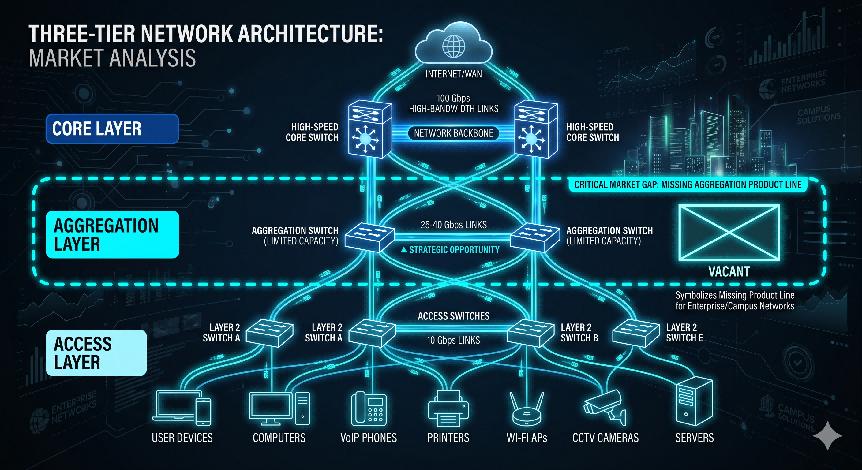
At that time, H3C had a complete portfolio including the S2X00 and S3X00 series low‑to‑mid‑end Layer 2/Layer 3 switches, as well as the S80XX series high‑end switches for backbone networks. However, it lacked a general‑purpose mid‑to‑high‑end Layer 3 switch targeting the aggregation/backbone layers of enterprise networks, aggregation/backbone layers of campus networks, and broadband metropolitan area networks (MANs).
Its benchmark competitor, Company C, already offered the C6500 series Layer 3 switches, which had been successfully deployed in enterprise network aggregation/backbone layers, campus network aggregation/backbone layers, broadband MANs, and other scenarios.
The Company C C6500 series Layer 3 switches were an industry icon: launched in 1999 with continuous version iterations, they had a product lifecycle exceeding 20 years and were not discontinued until October 30, 2020. The C6500 series set countless industry benchmarks, earned more than 500 patents, shipped over 1 million units total, and provided hundreds of millions of ports. It served generations of customers through the dot‑com era, cloud computing era, IoT era, and beyond.
As a latecomer, H3C aimed to compete with the C6500 series, which had been mature in the market for nearly five years. The newly developed general‑purpose mid‑to‑high‑end Layer 3 switch had to be comparable to the C6500 series in functions and performance, while offering sufficient price competitiveness. To boost morale and pay tribute to the C6500, H3C named the new product S6500 at the start of development.
S650 series overview: performance, architecture, reliability, and cost-performance
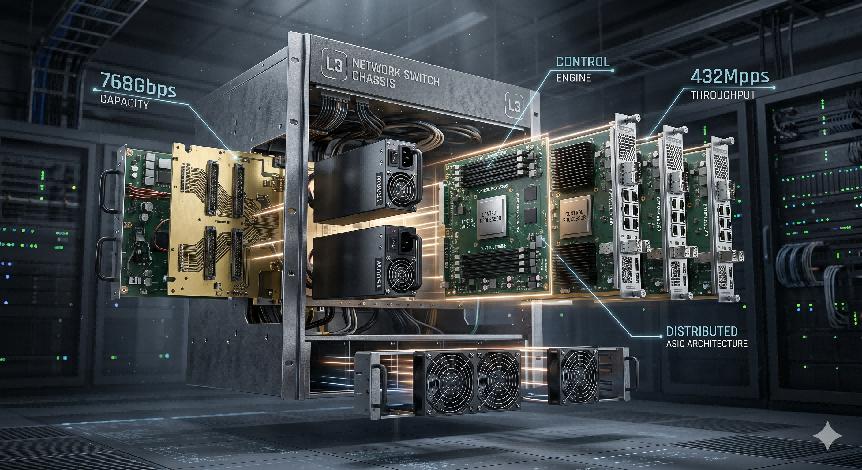
The S6500 series switches delivered a switching capacity of 768 Gbps, the highest in the industry at that time, with a data forwarding rate of 432 Mpps. It supported line‑rate forwarding for a large‑capacity specification: 288 GE ports or 24 10GE ports.
The S6500 featured a passive backplane, dual power supplies, redundancy for engines, power supplies, and fans, as well as hot‑swappable boards. These hardware designs ensured high reliability.
The S6500 series adopted an advanced fully distributed architecture. It achieved line‑rate distributed Layer 2/Layer 3 forwarding both within and between boards via switching chips integrated in the main engine and distributed high‑speed service interface boards. High‑performance ASICs on the distributed service interface boards worked with the CPU on the main processing engine to realize fully distributed processing of ACL, traffic classification, QoS, multicast, and other services. Its key functions were aligned with those of the C6500 series.
The S6500 series also incorporated numerous cost‑reduction measures, delivering exceptional cost‑performance.
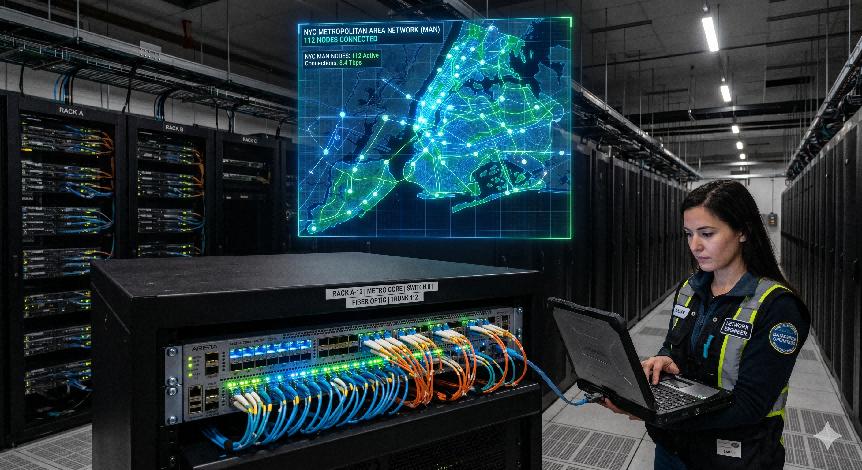
In late 2004, H3C's newly developed S6500 general‑purpose mid‑to‑high‑end Layer 3 switch was deployed in a trial network at 112 broadband MAN nodes of Friendly User XX Telecom, marking the beginning of its challenging market launch journey.
By Lanbras
Lanbras specializes in translating cutting-edge optical and Ethernet transmission technologies into clear, valuable insights that help our customers stay ahead in a fast-evolving digital world.
By turning complex technical concepts into practical, business-driven content, we aim to empower decision-makers with the knowledge they need to make confident, future-ready choices.
 EN
EN
 fr
fr  es
es  ru
ru  pt
pt  ar
ar  de
de 
 Internet Data Center
 FAQs
FAQs Industry News
 About Us
 Data Center Switch
  Enterprise Switch
  Industrial Switch
  Access Switch
  Integrated Network
  Optical Module & Cable

 Call us on:
  Email Us:
  2106B, #3D, Cloud Park Phase 1, Bantian, Longgang, Shenzhen, 518129, P.R.C.