After equipment arrival, verification and acceptance were carried out against the delivery list, followed by equipment installation. Equipment installation is divided into two parts: hardware installation and software installation. Hardware installation is performed by the local construction team under the supervision and guidance of the project delivery team. Software installation is conducted by product engineers led by respective Product TLs (Team Leaders) of the delivery project team, with the TD (Technology Director) responsible for overall technical coordination and quality control.
Hardware Installation Procedures for the IPTV Headend Equipment Room
1. Install cable trays one by one in accordance with the site survey report and cabinet layout diagram.
2. Install cabinet bases and cabinets one by one in accordance with the site survey report and cabinet layout diagram.
3. Install equipment inside cabinets one by one in accordance with the site survey report and cabinet layout diagram.
4. Route and install power cables, network cables and pigtails one by one in accordance with the site survey report and cabinet layout diagram.
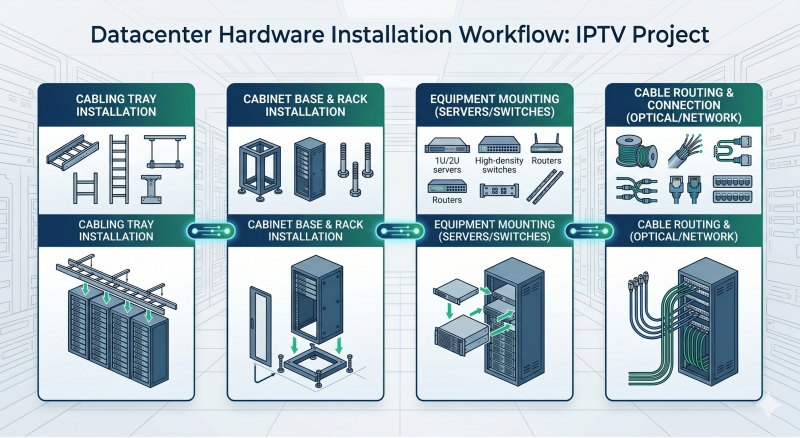
Hardware installation shall comply with hardware installation quality specifications. The principles of hardware installation quality specifications are clear classification, stable structure, reasonable airflow, standardized cabling, clear labeling and complete safety protection. Details are as follows:
Before installation, verify the installation environment item by item against the hardware installation prerequisite checklist to confirm compliance with hardware installation requirements.
Vertical deviation of cabinet installation shall not exceed 3mm; horizontal error shall not exceed 2mm per square meter. Cabinets installed side by side shall be on the same plane and parallel to the reference line, with front-rear deviation not exceeding 3mm. Gap between adjacent cabinets shall not exceed 3mm.
All parts of cabinets and equipment shall be free of loss or damage; any peeling paint shall be touched up, and all labels shall be clear and complete.
Installation of cabinets and equipment shall be firm; seismic reinforcement shall be applied as required if seismic requirements exist.
Cabinets shall be mounted on cabinet bases fixed firmly to the equipment room floor; anti-static floors shall be cut neatly and supported properly.
A clearance of 800mm shall be reserved in front of cabinets, and a distance of more than 600mm shall be kept from the rear of cabinets to the wall to facilitate installation, construction and later maintenance.
Equipment installation inside cabinets shall start after cabinet installation is completed; equipment mounted in cabinets shall be firm and upright.
All screws, gaskets, spring washers and other fasteners shall be securely fastened as required without omission.
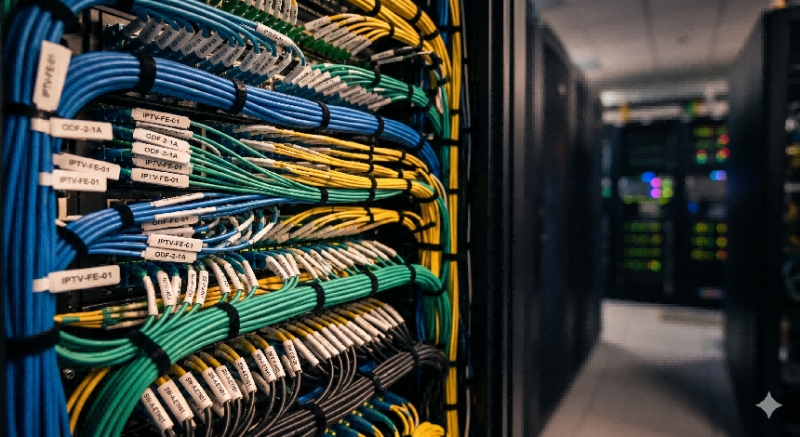
Clear temporary labels shall be used for all cables and terminals during installation; all temporary labels shall be replaced with neat, clear printed labels after installation is completed.
All cables shall be routed in properly separated and orderly manner; cable routing shall comply with bending radius and stacking requirements; cable bundling shall meet applicable specifications.
Dust screens and rodent screens of cabinets shall be properly installed; cable routing openings shall be well sealed.

Each type of equipment (cabinets, servers, firewalls, switches, routers, etc.) has its own hardware installation guide. In case of conflicts among hardware installation guides during installation, the TD shall coordinate and resolve such issues.
Upon completion of hardware installation, self-inspection and rectification shall be performed against the hardware installation self-inspection checklist. Then acceptance shall be conducted jointly with the Construction Department of Magyar Telekom in accordance with the hardware installation acceptance manual. Power-on is allowed only after acceptance is passed.
Software Installation Procedures for the IPTV Headend Equipment Room
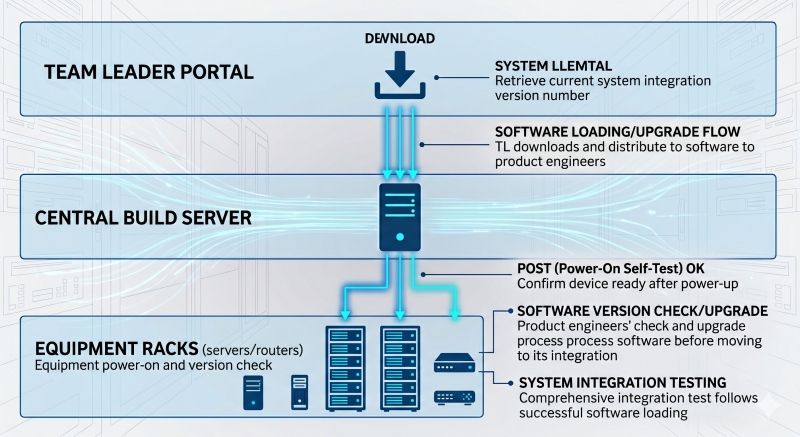
1. Based on the integrated version number of the IPTV system, each Product TL applies for and downloads the software version of the respective product and distributes it to corresponding product engineers.
2. After equipment power-on, each product engineer performs self-inspection on the equipment and verifies software version information upon passing self-inspection.
3. Perform software upgrade for products requiring upgrade after verification in accordance with the corresponding software upgrade guide for each product.
Upon completion of software installation, the project enters the phase of software commissioning and system integration.
By Lanaotek
Lanaotek specializes in translating cutting-edge optical and Ethernet transmission technologies into clear, valuable insights that help our customers stay ahead in a fast-evolving digital world.
By turning complex technical concepts into practical, business-driven content, we aim to empower decision-makers with the knowledge they need to make confident, future-ready choices.
 EN
EN
 fr
fr  es
es  ru
ru  pt
pt  ar
ar  de
de 
 Internet Data Center
 FAQs
FAQs Industry News
 About Us
 Data Center Switch
  Enterprise Switch
  Industrial Switch
  Access Switch
  Integrated Network
  Optical Module & Cable


.webp "Choosing Between L2+ and Layer 3 Managed Switches for Enterprise Networks: 2026 B2B Procurement Guide")
 Call us on:
  Email Us:
  2106B, #3D, Cloud Park Phase 1, Bantian, Longgang, Shenzhen, 518129, P.R.C.