In late 2004, H3C's newly developed S6500 general-purpose mid-to-high-end Layer 3 switch was delivered for trial deployment at 112 broadband MAN nodes of friendly user XX Telecom. As user services were gradually cut over, a severe shortcoming was exposed: the S6500 product team had insufficient understanding of the application scenarios of Layer 3 switches in broadband MANs.
In previous common scenarios, multiple physical ports were typically assigned to one VLAN. Based on this experience, the S6500 was designed with 64 Interface VLAN interfaces to match its 288 GE or 24 10GE physical ports.
Starting from 2001, blockbuster massively multiplayer online games such as StarCraft, Legend of Mir 2, and Warcraft III, together with QQ chat and forums like Xici Hutong and Tianya, experienced explosive growth. Internet cafes quickly spread across every street. As competition among internet cafes intensified, all of them applied for dedicated fiber lines from local telecom operators to guarantee network speed, and advertised “fiber-optic Internet access” to attract customers.
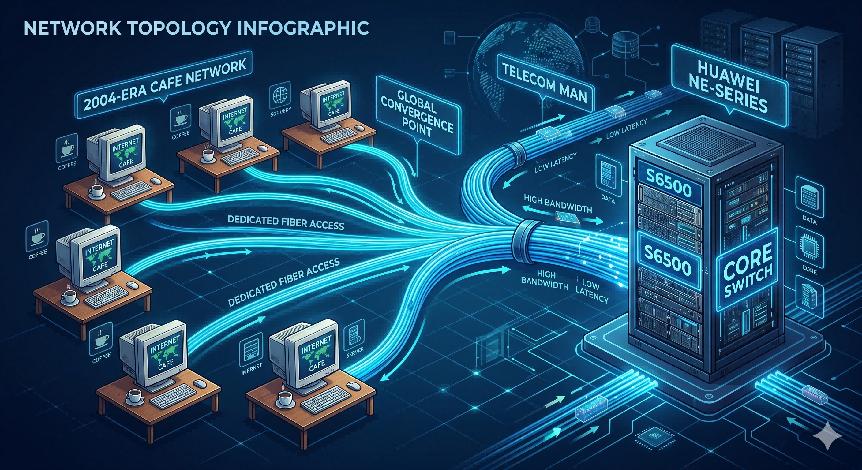
After the S6500 was put into service, XX Telecom promoted to internet cafe users that their network devices had been upgraded, supporting gigabit fiber-optic access for smoother Internet experience. Internet cafe users paid for the upgrade one after another. Existing internet cafe users were cut over to the S6500, and new users were provisioned on the S6500.
Now came the second tribulation of the S6500! The S6500 had a maximum of 288 GE physical ports, supporting up to 288 internet cafe users. Each internet cafe was a key customer requiring a dedicated line, which meant a dedicated physical port and a dedicated IP address. However, the S6500 was designed with only 64 Interface VLAN interfaces in total; at most 62 could be assigned to internet cafe users (the other 2 were reserved for dual uplink interconnection of the S6500). A severe specification limitation emerged.
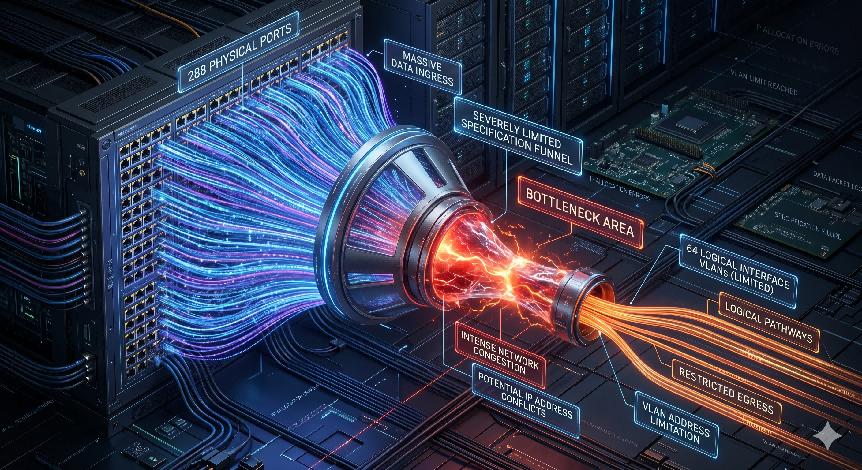
To handle the massive cutover and provisioning demand from internet cafe users, a temporary solution had to be adopted: every 8 internet cafe users shared one Interface VLAN interface, i.e., shared one IP gateway. Since 8 users were under the same gateway, there was a risk of mutual attacks between internet cafes. The R&D team was required to resolve the Interface VLAN specification limitation as soon as possible.
Drawing on the design concepts of Super VLAN and Sub VLAN, the S6500 R&D team released a new software version. In this version, a primary/secondary Interface VLAN mechanism was introduced: each existing Interface VLAN was extended to support 8 secondary Interface VLANs, solving the shortage of Interface VLAN resources. The S6500 trial support team then upgraded the software version on all S6500 switches at the 112 trial nodes, barely overcoming the second tribulation.
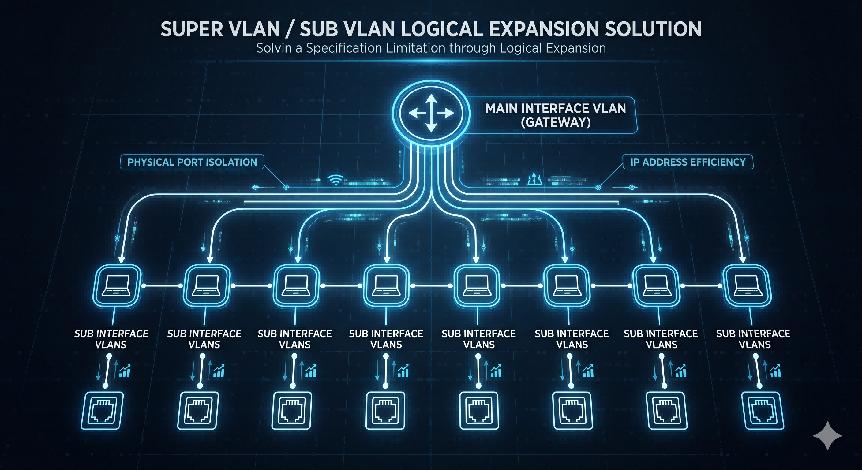
Although the primary/secondary Interface VLAN scheme resolved the specification limitation, it also complicated VLAN planning, IP addressing, and configuration commands. Engineers from XX Telecom were unaccustomed to this complexity and repeatedly asked when the original clean configuration could be restored.
By Lanaotek
Lanaotek specializes in translating cutting-edge optical and Ethernet transmission technologies into clear, valuable insights that help our customers stay ahead in a fast-evolving digital world.
By turning complex technical concepts into practical, business-driven content, we aim to empower decision-makers with the knowledge they need to make confident, future-ready choices.
 EN
EN
 fr
fr  es
es  ru
ru  pt
pt  ar
ar  de
de 
 Internet Data Center
 FAQs
FAQs Industry News
 About Us
 Data Center Switch
  Enterprise Switch
  Industrial Switch
  Access Switch
  Integrated Network
  Optical Module & Cable


 Call us on:
  Email Us:
  2106B, #3D, Cloud Park Phase 1, Bantian, Longgang, Shenzhen, 518129, P.R.C.