Deploying network infrastructure in outdoor environments presents a unique set of challenges that indoor enterprises never have to face. Whether you are setting up IP surveillance cameras across a sprawling industrial complex, deploying public Wi-Fi in a smart city project, or connecting remote IoT sensors, maintaining a stable network connection is critical. At the heart of these deployments sits the outdoor poe switch box, a specialized enclosure tasked with a massive responsibility: protecting your active networking hardware from the unforgiving elements while ensuring continuous power and data delivery.
Choosing the right enclosure requires more than just picking a box that fits your budget. It demands an understanding of material science, thermal dynamics, and ingress protection. Making the wrong choice can lead to catastrophic hardware failure, expensive truck rolls, and prolonged network downtime. This comprehensive guide will walk you through the essential factors required to select a professional-grade enclosure that guarantees long-term network reliability.
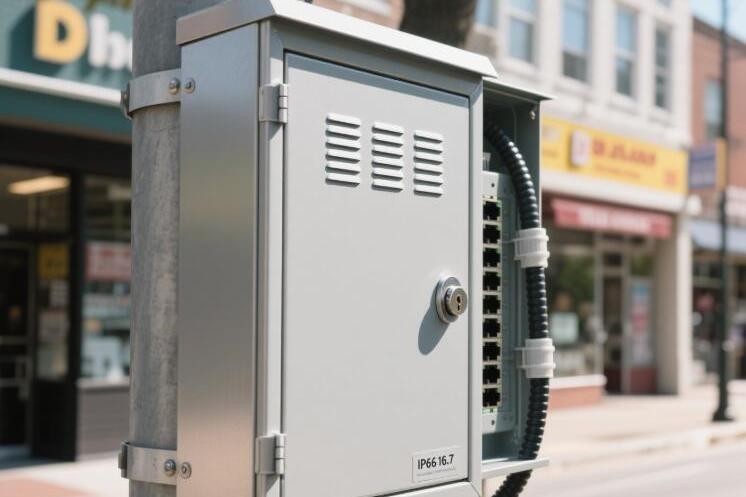
Why Standard Network Enclosures Fail Outdoors: The Risks of Weather and Dust
It can be tempting to repurpose a standard IT enclosure or a generic junction box for an outdoor deployment to save upfront costs. However, standard indoor or mild-environment enclosures are fundamentally unsuited for open-air installations. When you deploy an outdoor network switch without industrial-grade protection, you expose your active electronics to a cocktail of environmental hazards that will quickly degrade and destroy sensitive circuitry.
Moisture is the most immediate threat. Rain, driving snow, and high humidity can penetrate poorly sealed seams, causing immediate short circuits or triggering rapid oxidation on the copper pins of RJ45 ports and internal printed circuit boards. Even if liquid water does not enter, diurnal temperature swings create condensation inside an unsealed box, trapping moisture directly on the electronics.
Dust and airborne particulates pose an equally dangerous, albeit slower, threat. In industrial sites or roadside deployments, fine dust particles find their way through small gaps. This dust accumulates on the components of your outdoor network switch, acting as an insulating blanket that traps heat. It can also jam small cooling fans or create static discharge pathways that cause intermittent data packet loss or total hardware failure. Furthermore, standard indoor plastics degrade rapidly under solar radiation, becoming brittle and cracking within a few months of continuous sun exposure.
Key Features to Look For in a Professional Outdoor Network Switch Box
A professional-grade outdoor poe switch box is engineered specifically to counteract these environmental threats while simplifying the deployment process. When evaluating enclosures for your project, you should look for features that go beyond basic physical protection and actively contribute to operational efficiency.
First, look for heavy-duty, integrated locking mechanisms. Outdoor enclosures are frequently installed in public or semi-public spaces, making physical security and tampering prevention a top priority. High-quality boxes feature dual-lock designs or pad-lockable latches made from stainless steel to prevent unauthorized physical access to your network.
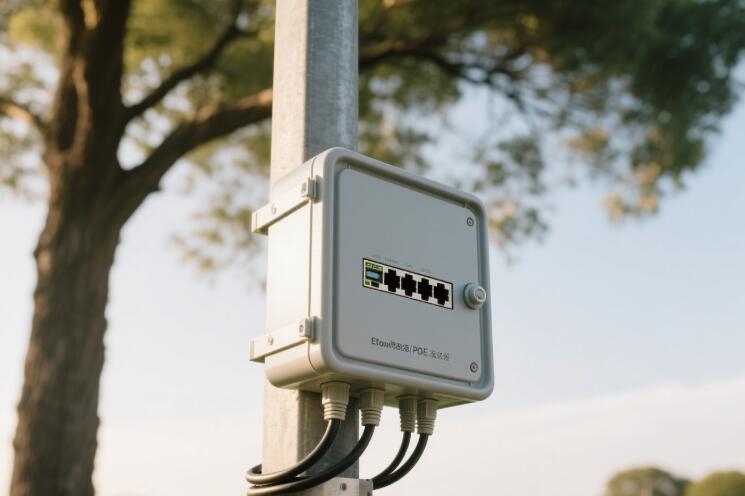
Second, pay close attention to the cable entry and exit points. A premium outdoor network switch box will feature pre-drilled or customizable knockouts equipped with high-quality liquid-tight cable glands. These glands compress around the incoming Ethernet and power cables, creating a hermetic seal that prevents water and insects from crawling inside the housing.
Finally, consider the internal layout and mounting flexibility. The enclosure should offer integrated DIN-rail tracks or adjustable internal mounting plates. This allows you to securely fasten the outdoor network switch, power supplies, and surge protectors, keeping the internal wiring organized and reducing the risk of accidental disconnection during routine maintenance.

Understanding IP Ratings: Do You Need IP65 or IP67 Protection?
The Ingress Protection (IP) rating system is the international standard used to define the sealing effectiveness of electrical enclosures against intrusion from foreign bodies and moisture. When selecting an outdoor poe switch box, the IP rating is your primary metric for verifying environmental resilience. The rating consists of two digits: the first represents protection against solids (ranging from 0 to 6), and the second represents protection against liquids (ranging from 0 to 9).
For outdoor networking, you will primarily encounter IP65 and IP67 ratings. Understanding the technical distinction between them is crucial for matching the enclosure to your specific geographic and environmental conditions.
| Feature / Capability | IP65 Rating | IP67 Rating |
|---|
| Solid Protection (1st Digit) | 6: Completely dust-tight. No ingress of dust possible. | 6: Completely dust-tight. No ingress of dust possible. |
| Liquid Protection (2nd Digit) | 5: Protected against water jets projected by a nozzle from any direction. | 7: Protected against the effects of temporary immersion in water. |
| Testing Parameter | Water pressure of 30 kPa at a distance of 3 meters for 3 minutes. | Submersion in water at a depth of 1 meter for 30 minutes. |
| Best Application Environments | Standard vertical walls, under building eaves, general roadside poles. | Low-lying areas prone to flash flooding, heavy marine spray zones, extreme washdown areas. |
An IP65-rated outdoor poe switch box offers excellent protection for the vast majority of standard outdoor deployments. It easily repels wind-driven rain, winter snowstorms, and airborne dust. However, if your installation site is located in a coastal region experiencing intense maritime storms, or if the box is mounted low to the ground in an area prone to seasonal flash flooding, upgrading to an IP67 enclosure is highly recommended to prevent catastrophic failure during temporary water submersion.
Materials Matter: Aluminum vs. UV-Stabilized Plastics for Longevity
The material composition of your enclosure directly dictates its operational lifespan, structural integrity, and overall weight. The two dominant materials utilized in the manufacturing of high-quality industrial enclosures are aluminum alloys and engineering-grade, UV-stabilized plastics (such as polycarbonate or fiberglass-reinforced polyester).
Aluminum Alloys
Die-cast or extruded aluminum offers unmatched ruggedness. It provides exceptional impact resistance, making it the ideal choice for high-traffic environments where vandalism or accidental physical impacts are a risk. Aluminum naturally resists corrosion when treated with a high-grade powder coating, and it acts as an excellent natural heat sink, helping to dissipate internal thermal energy. However, aluminum is significantly heavier than plastic and can increase shipping and installation complexity, especially when mounting high on telecommunication poles.
UV-Stabilized Plastics
Advanced polycarbonates and composites have become incredibly popular for modern deployments. These materials are lightweight, highly impact-resistant, and completely immune to rust and galvanic corrosion, making them outstanding for high-salinity coastal environments. The critical factor is ensuring the plastic is explicitly rated as "UV-stabilized." Without this chemical stabilization, standard plastics will quickly degrade, become brittle, and discolor under direct sunlight, eventually cracking and compromising the internal seal.
Thermal Management: Keeping Your PoE Switch Cool in Direct Sunlight
Thermal management is often the most overlooked aspect of outdoor network design, yet it is a primary cause of hardware instability. When you place an active outdoor network switch inside a sealed box exposed to direct sunlight, you create a greenhouse effect. Solar radiation beats down on the exterior surface, while the PoE switch internally generates heat as it processes data and distributes power to connected PDs (Powered Devices).
Without proper thermal mitigation, the internal temperature can easily soar past 60°C (140°F), exceeding the maximum operating temperature of standard commercial switches and causing them to throttle performance, drop packets, or shut down entirely.
To keep your electronics running cool, consider the following thermal management strategies:
Passive Ventilation: Enclosures equipped with dual, baffled side vents allow hot air to escape while drawing cooler air in from the bottom. These vents must be designed with fine mesh screens to keep insects and debris out while maintaining the box's IP integrity.
Reflective Finishes: Opt for enclosures finished in light grey or off-white. These light colors reflect a massive percentage of solar radiation compared to dark colors, significantly lowering the baseline internal temperature.
Integrated Heat Sinks and Fans: For high-wattage PoE applications, look for enclosures that feature internal cooling fans or metal heat-conducting plates that draw heat away from the switch chassis and radiate it out through the enclosure walls.
Conclusion
Building an outdoor network that survives the test of time requires a deliberate approach to hardware protection. Relying on makeshift setups will inevitably result in network downtime and expensive repairs. By choosing a specialized outdoor poe switch box that offers verified IP65 or IP67 ingress protection, robust UV-stabilized or aluminum construction, and intelligent thermal management, you can ensure your outdoor networking equipment operates seamlessly for years to come.
At Lanaotek, we understand that robust outdoor connectivity is the backbone of modern smart cities, industrial automation, and advanced security infrastructure. As part of our comprehensive commitment to manufacturing cutting-edge Optical and Ethernet Transmission solutions, we design hardware built to endure the most challenging conditions. Our industrial network switches and protection accessories are engineered to meet strict international compliance standards, providing global system integrators and enterprises with the reliability, sustainability, and performance needed to keep the world securely connected.
Frequently Asked Questions (FAQ)
1. Can I install a standard desktop PoE switch inside an outdoor weatherproof box?
While physically possible if space permits, it is highly discouraged. Desktop switches are designed for climate-controlled environments and have low maximum operating temperatures. For reliable outdoor operations, you should pair your enclosure with an industrially rated industrial network switch that features extended operating temperature ranges (typically -40°C to 75°C).
2. How do I prevent condensation from building up inside a sealed outdoor network switch box?
Rapid temperature fluctuations between day and night can cause moisture in the air to condense inside a completely sealed box. To prevent this, you can utilize specialized breathable membrane vents (such as Gore vents) that allow air molecules to pass through to equalize pressure and moisture while completely blocking liquid water. Alternatively, placing silica gel desiccant packs inside the box helps absorb residual humidity.
3. Do I need to ground my outdoor poe switch box?
Yes, electrical grounding is absolutely essential for all outdoor deployments. If your enclosure is made of aluminum, the chassis must be bonded to an earth ground. Even if you use a plastic enclosure, internal components like surge protectors and the outdoor network switch itself must be properly connected to a dedicated ground wire to safely dissipate power surges caused by lightning strikes or grid fluctuations.
4. What is the maximum distance I can run an Ethernet cable to an outdoor network switch?
Following standard IEEE 802.3 specifications, the maximum distance for copper twisted-pair Ethernet cabling (such as Cat5e, Cat6, or Cat7) is 100 meters (approximately 328 feet) for both data and PoE transmission. If your outdoor deployment requires distances greater than this, you should look into integrating fiber optic uplinks into your network design. You can browse our advanced transport options on our optical transmission equipment collection page to find long-distance connectivity solutions.
 EN
EN
 fr
fr  es
es  ru
ru  pt
pt  ar
ar  de
de 
 Internet Data Center
 FAQs
FAQs Industry News
 About Us
 Data Center Switch
  Enterprise Switch
  Industrial Switch
  Access Switch
  Integrated Network
  Optical Module & Cable



 Call us on:
  Email Us:
  2106B, #3D, Cloud Park Phase 1, Bantian, Longgang, Shenzhen, 518129, P.R.C.