There are multiple service bearing solutions for the service layer of a 4G mobile bearer network.
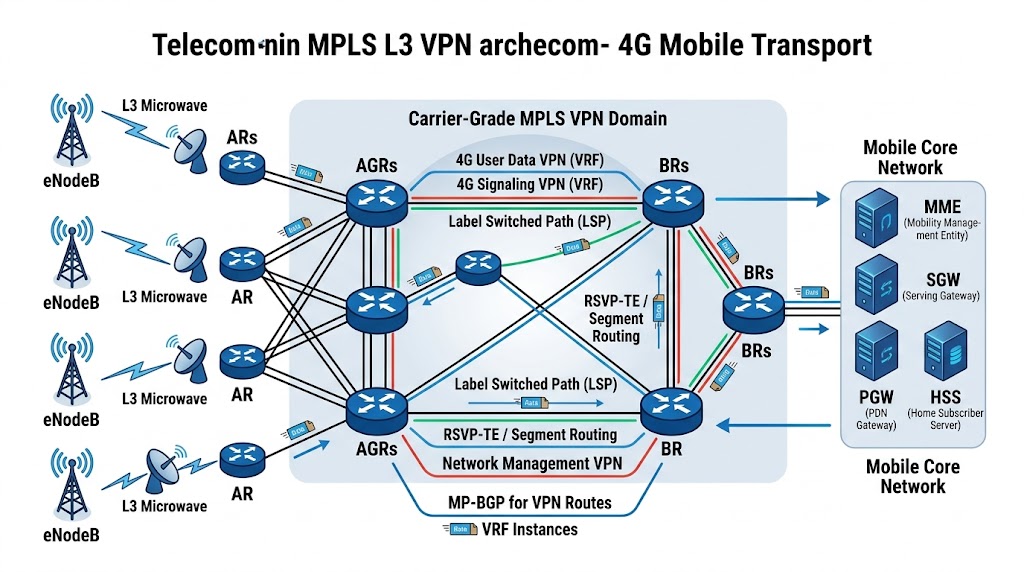
The mainstream basic bearing architectures are listed below:
L2 Microwave + L2 Access Data Communication + L3 Aggregation Data Communication + L3 Backbone Data Communication
L2 Microwave + L3 Access Data Communication + L3 Aggregation Data Communication + L3 Backbone Data Communication
L3 Microwave + L3 Access Data Communication + L3 Aggregation Data Communication + L3 Backbone Data Communication
Further divided by specific technical implementations, the detailed bearing solutions are as follows:
L2 Microwave + L2 Access Data Communication + L3 Aggregation Data Communication + L3 Backbone Data Communication
VLAN + VLAN + |<----- MPLS L3 VPN ---->|
L2 Microwave + L3 Access Data Communication + L3 Aggregation Data Communication + L3 Backbone Data Communication
VLAN + MPLS L3 VPN + |<----- MPLS L3 VPN ---->|
L2 Microwave + L3 Access Data Communication + L3 Aggregation Data Communication + L3 Backbone Data Communication
VLAN + |<----- MPLS L3 VPN ---->|
L3 Microwave + L3 Access Data Communication + L3 Aggregation Data Communication + L3 Backbone Data Communication
|<----- MPLS L3 VPN ---->| + |<----- MPLS L3 VPN ---->|
L3 Microwave + L3 Access Data Communication + L3 Aggregation Data Communication + L3 Backbone Data Communication
|<----- MPLS L3 VPN ---->|
After taking into account the future capacity expansion and evolution of the mobile bearer network, technical maturity of bearing schemes and subsequent maintenance complexity, Telenor Myanmar finally adopted the solution of L3 Microwave plus segmented MPLS L3 VPN.
With the bearing solution confirmed, the mobile bearer network planning report for Telenor Myanmar was compiled by fine-tuning Company H's standard 4G mobile bearer network solution in accordance with the operator's technical requirements. The report covers the following contents:
The network adopts the architecture of L3 Microwave + L3 Access Data Communication + L3 Aggregation Data Communication + L3 Backbone Data Communication.
L3 backbone and L3 aggregation data communication devices are deployed in a rectangular ring topology.
L3 access data communication devices adopt a combination of ring and chain topologies; a single ring contains no more than 8 devices, and a single chain contains no more than 4 devices.
L3 microwave links are deployed in chain topology, with a maximum of 3 devices per chain.
A hierarchical traffic convergence mode is applied:
No traffic convergence between base stations and microwave devices.
Traffic convergence ratio of 1:3 between microwave devices and access data communication devices.
Traffic convergence ratio of 1:3 between access data communication devices and aggregation data communication devices.
No traffic convergence between aggregation data communication devices and backbone data communication devices.
Expansion interfaces are reserved at all convergence points.
According to capacity calculation results:
Microwave devices are configured with GE uplinks in general.
10GE ports are used for ring and chain interconnection of access data communication devices.
Aggregation data communication devices adopt 40GE networking.
Backbone data communication devices adopt 200GE networking.
Carrier-grade high-reliability equipment is deployed throughout the network. The network topology is designed to avoid single-chain links, single uplinks and single-point failures as much as possible.
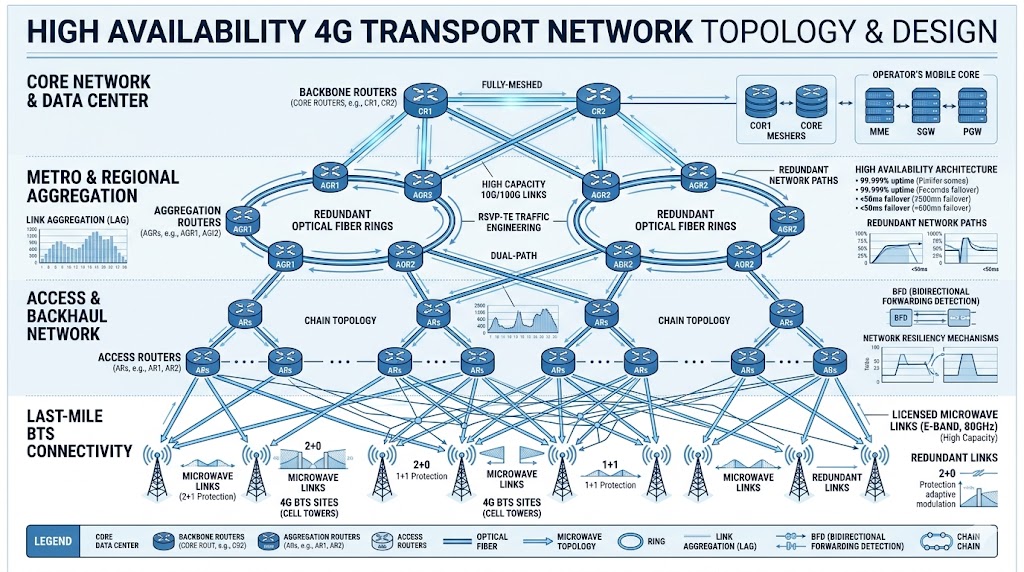
The mobile bearer network is divided into different regions in line with Myanmar's geographical divisions, administrative divisions and the service scope of Telenor Myanmar's maintenance teams. Relevant planning is then implemented for each region, including routing protocol area numbers, IP address segments and device naming conventions.
Following the service path: Base Station → L3 Microwave (MPLS L3 VPN) → L3 Aggregation Data Communication (MPLS L3 VPN) → Mobile Core Network, QoS mapping is implemented layer by layer.QoS levels of different services on base stations are mapped to MPLS QoS levels of L3 microwave links, which are further mapped to MPLS QoS levels of L3 aggregation data communication devices, and finally aligned with service QoS levels of the mobile core network. A unified service QoS level mapping table is formulated for subsequent unified configuration.

Firewalls are deployed at the ingress of all server clusters. Security authentication and record filing are mandatory for all device logins. All unnecessary external interfaces of the entire network are disabled.
Remote authentication and filing are enabled for access control of all sites. All network devices are centrally managed by the network management center. Only in-band management channels are deployed for network operation, and no independent dedicated network management network is built due to high construction costs.
The service layer planning of the mobile bearer network is the final module of the overall network planning work. Once the deliverables are reviewed and approved by Telenor Myanmar, follow-up work including site survey, equipment production and stock preparation, and detailed network design can be launched.
By Lanaotek
Lanaotek specializes in translating cutting-edge optical and Ethernet transmission technologies into clear, valuable insights that help our customers stay ahead in a fast-evolving digital world.
By turning complex technical concepts into practical, business-driven content, we aim to empower decision-makers with the knowledge they need to make confident, future-ready choices.
 EN
EN
 fr
fr  es
es  ru
ru  pt
pt  ar
ar  de
de 
 Internet Data Center
 FAQs
FAQs Industry News
 About Us
 Data Center Switch
  Enterprise Switch
  Industrial Switch
  Access Switch
  Integrated Network
  Optical Module & Cable

 Call us on:
  Email Us:
  2106B, #3D, Cloud Park Phase 1, Bantian, Longgang, Shenzhen, 518129, P.R.C.