Different functional buildings vary in internal space layout, as well as the type, quantity and density of connected end-user terminals, thus requiring differentiated access solutions.
Canteens, auditoriums, gymnasiums, natatoriums and libraries feature large, open indoor spaces. The connected terminals are mainly smartphones and tablets with large quantities and high user density, alongside a small number of campus and merchant devices requiring stable network access. Such buildings adopt a solution dominated by high-capacity high-performance AP Wi-Fi access, supplemented by wired Ethernet access.
Dormitory buildings and classrooms contain numerous partition walls. Terminals are mostly smartphones and tablets with moderate quantity and density, plus a small number of IP phones and PCs demanding stable connectivity. These areas deploy standard AP Wi-Fi access as the primary access mode, with wired Ethernet as a supplement.
Laboratory buildings and labs prioritize fiber and wired Ethernet access, with standard AP Wi-Fi as an auxiliary option or no Wi-Fi deployment at all to eliminate unnecessary signal interference within lab environments.
Stadium stands and podiums adopt high-capacity high-performance outdoor AP access as the main solution, with wired Ethernet as a backup.
In an ideal open environment, an AP can cover a radius of 100 meters. However, obstacles such as microwave ovens, induction cookers, other APs and partition walls generate radio interference, shrinking AP coverage and degrading signal quality.
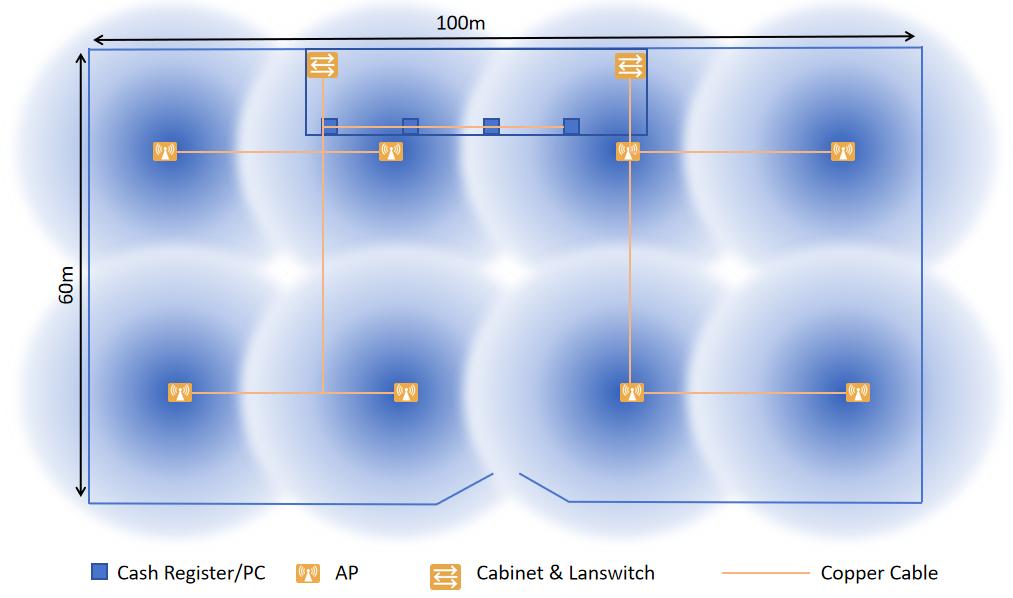
For open, unobstructed scenarios including canteens, auditoriums and stadiums, the recommended AP coverage radius ranges from 30 to 45 meters. In addition, these venues may accommodate up to 2,000 concurrent users. Taking both factors into comprehensive consideration, the AP coverage radius for canteens, auditoriums and stadiums is set to approximately 30 meters, and high-capacity high-performance AP models supporting over 150 concurrent users are selected.
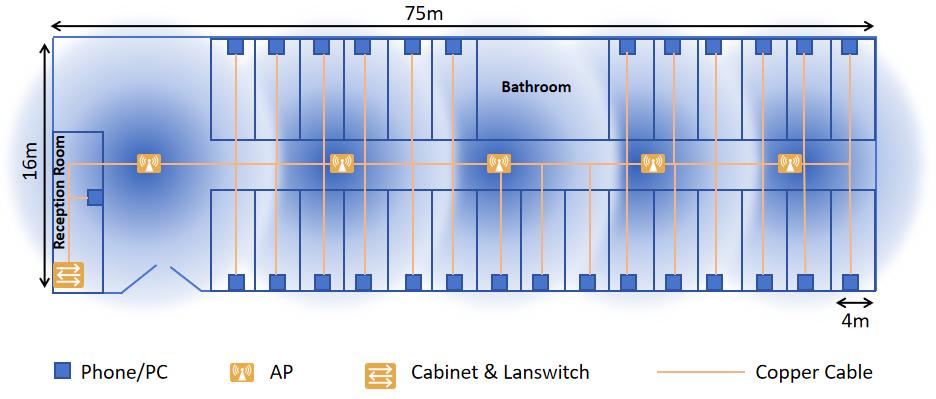
For student dormitories with dense partition walls, although the theoretical coverage radius of an AP can reach 15–20 meters under ideal conditions, the actual deployment spacing is recommended to be 8–10 meters. Each dormitory unit serves around 10 end users. Based on the above analysis, the AP coverage radius for dormitories is defined as roughly 8 meters, and standard AP models are sufficient.
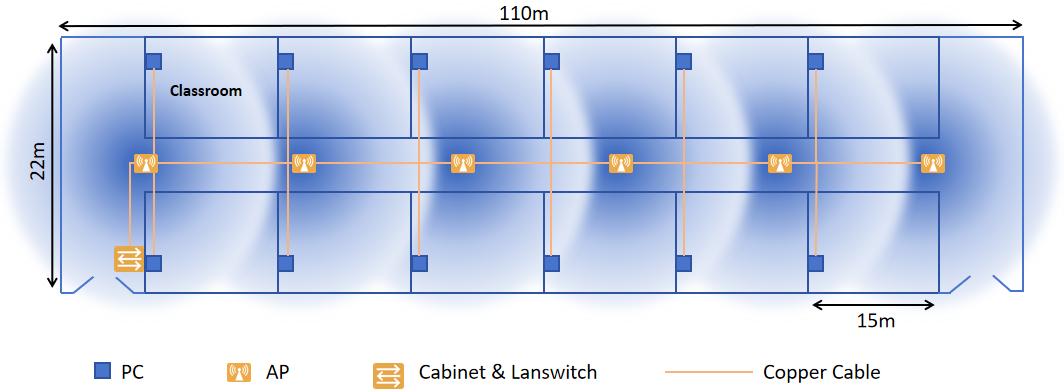
Classrooms have relatively few partition walls and each classroom carries about 80 terminals. The AP coverage radius is set to around 10 meters, and high-capacity high-performance AP models supporting more than 150 concurrent users are adopted.
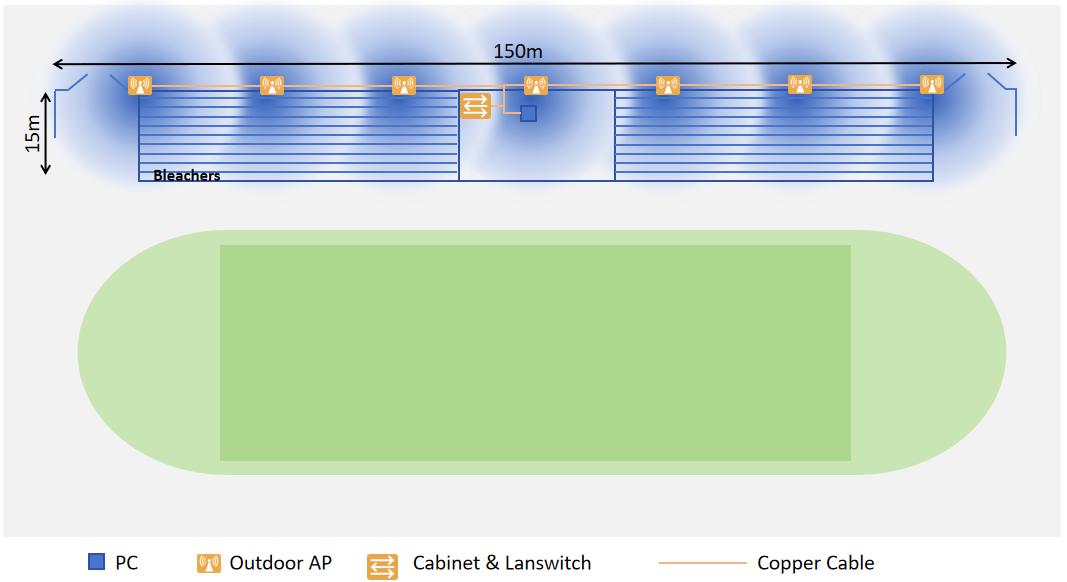
Stadium stands and podiums are outdoor and semi-outdoor scenarios, with a maximum of roughly 1,000 concurrent users. After comprehensive evaluation, the AP coverage radius for stadium stands and podiums is specified as approximately 15 meters. High-capacity high-performance outdoor AP models supporting over 150 concurrent users are selected and mounted on poles.
By Lanaotek
Lanaotek specializes in translating cutting-edge optical and Ethernet transmission technologies into clear, valuable insights that help our customers stay ahead in a fast-evolving digital world.
By turning complex technical concepts into practical, business-driven content, we aim to empower decision-makers with the knowledge they need to make confident, future-ready choices.
 EN
EN
 fr
fr  es
es  ru
ru  pt
pt  ar
ar  de
de 
 Internet Data Center
 FAQs
FAQs Industry News
 About Us
 Data Center Switch
  Enterprise Switch
  Industrial Switch
  Access Switch
  Integrated Network
  Optical Module & Cable

 Call us on:
  Email Us:
  2106B, #3D, Cloud Park Phase 1, Bantian, Longgang, Shenzhen, 518129, P.R.C.