Mobile bearer network planning covers four sub-systems: Microwave, Fiber, Optical Transmission and Data Communication.
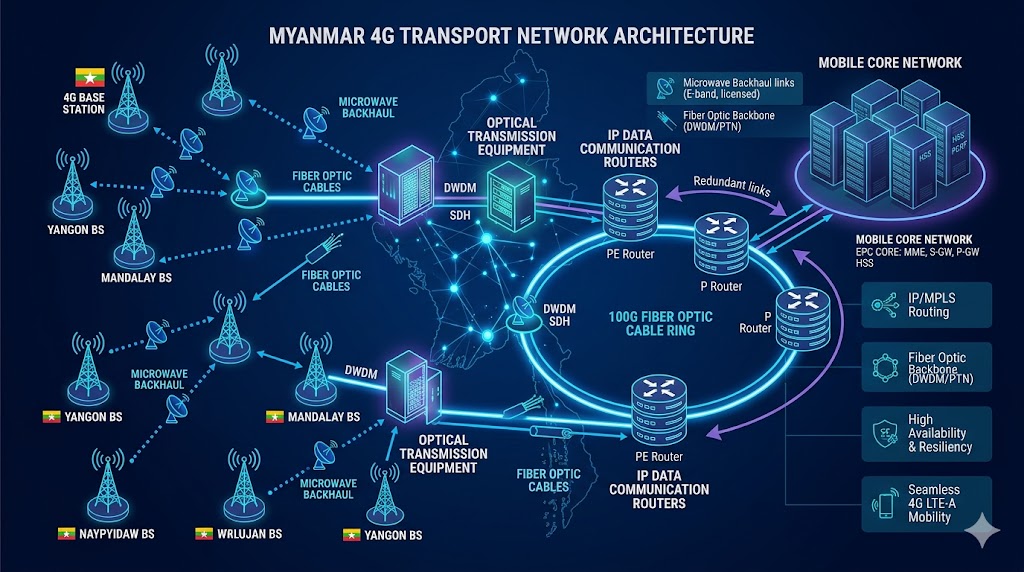
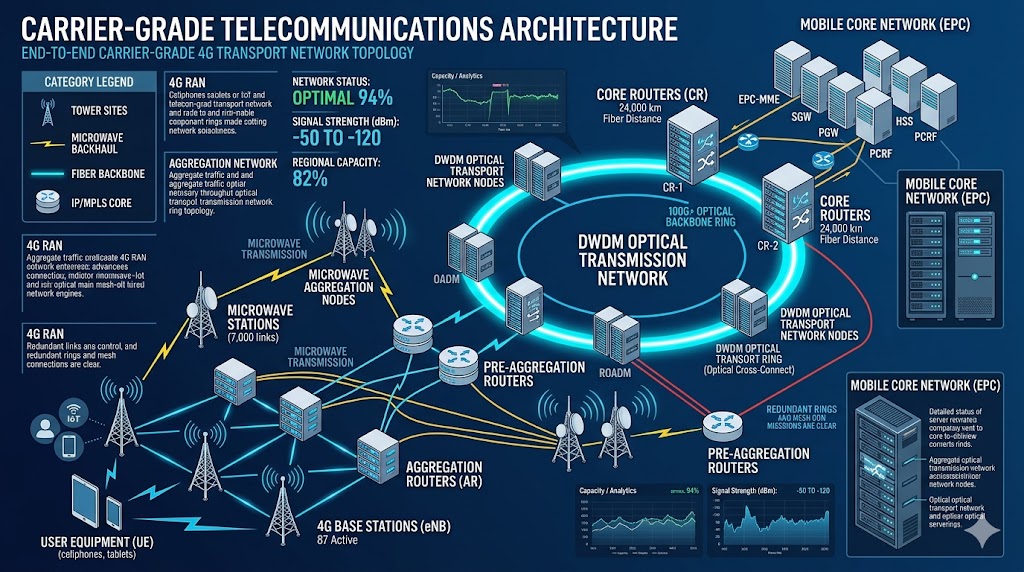
Mobile bearer network planning is divided into two layers: the physical layer and the service layer. The physical layer refers to the interconnection between radio base stations and mobile core network devices via microwave links, optical fibers and optical channels. The service layer focuses on establishing various service channels from radio base stations to the mobile core network.
After the site lists and bearing requirements are finalized for the mobile core network and radio access network respectively, the core task of mobile bearer network planning is to connect all radio access network sites with mobile core network sites at both the physical layer and service layer.
The mainstream end-to-end physical connection modes from radio base stations to the mobile core network are listed as follows:
Base station → Microwave equipment → Data communication access equipment → Metropolitan DWDM equipment / Optical fiber → Data communication aggregation equipment → Backbone DWDM equipment / Optical fiber → Data communication core equipment → Mobile core network equipment
Base station → Data communication access equipment → Metropolitan DWDM equipment / Optical fiber → Data communication aggregation equipment → Backbone DWDM equipment → Data communication core equipment / Optical fiber → Mobile core network equipment
Base station → Data communication aggregation equipment → Backbone DWDM equipment / Optical fiber → Data communication core equipment → Mobile core network equipment
As mentioned previously, Telenor Myanmar adheres to the network deployment principle: prioritize leasing over new construction, minimize self-built facilities, and deploy equipment centrally wherever feasible. Therefore, the sites of mobile bearer network devices and optical fiber routes are designed to align with existing DWDM sites and fiber routes of MPT, so as to lease MPT's available DWDM optical channel resources and fiber core resources directly.
4G base stations generate a sharp surge in bandwidth demand, while microwave links have limited bearing capacity. For this reason, MPT did not lease its existing microwave links to support Telenor Myanmar's 4G base stations. In addition, due to the complexity of service bearing schemes and daily maintenance for data communication networking, all telecom operators build their independent data communication networks.
The physical layer planning of Telenor Myanmar's mobile bearer network is implemented on Google Earth following the steps below:
Import all planned base station sites of the radio access network, core network sites, MPT's DWDM sites and MPT's fiber routes into separate layers on Google Earth.
Formulate overall microwave planning principles by taking into account the bandwidth and latency requirements of 4G services over microwave links, Telenor Myanmar's microwave spectrum resources, as well as the construction cost and deployment cycle of different types of microwave sites. Create a new microwave layer, then select Type A and Type B microwave sites and determine microwave site models in accordance with the planning principles. Since different microwave site models vary greatly in construction cost, high-cost models shall be selected with caution.
Create a new data communication layer. Select microwave convergence points as data communication access sites based on microwave planning results; select nodes of MPT's metropolitan DWDM sites and metropolitan fiber routes as data communication aggregation sites; select nodes of MPT's backbone DWDM sites, backbone fiber routes and mobile core network sites as data communication backbone sites.
Create a new optical fiber layer. Plan routes for new optical fibers in compliance with fiber planning principles and the requirements for ring and chain topology of all data communication sites. New optical fibers are deployed to complete ring and chain connections that cannot be realized via existing MPT fiber resources. Given the high cost and long construction cycle of new fiber deployment, the quantity of newly-built optical fibers shall be minimized.
Create a new DWDM layer. Select sites for new DWDM systems by comprehensively analyzing fiber distribution, redundant inter-site links, construction cost of new DWDM equipment and leasing cost of fiber cores.
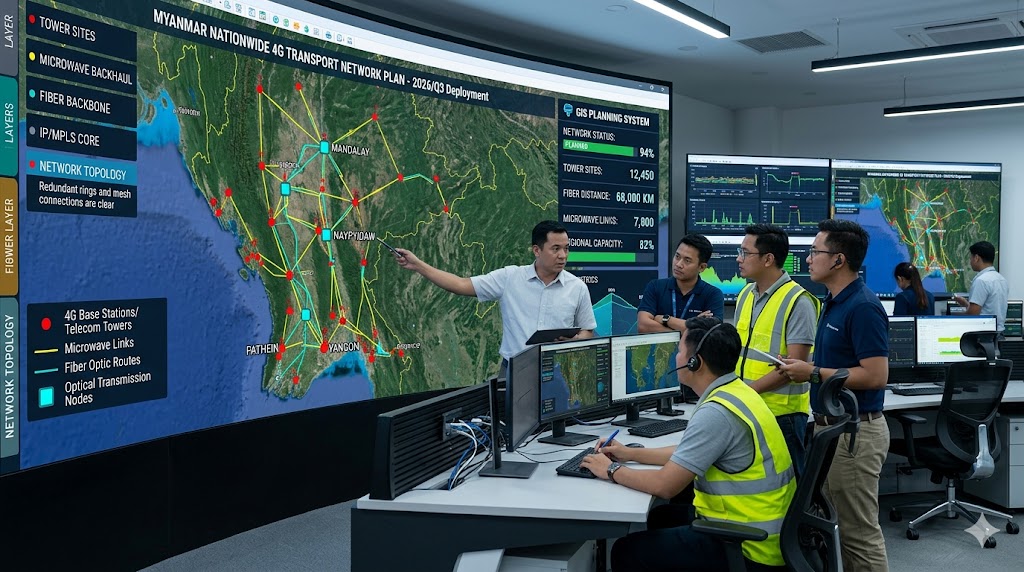
Throughout the above planning process, it is required to coordinate and unify the planning of microwave, optical fiber, data communication and DWDM systems, with full consideration of their respective construction cost, deployment difficulty and project cycle. The ultimate goal is to meet all service bearing requirements while minimizing the overall construction cost and shortening the deployment cycle of the mobile bearer network.
Upon completion of physical layer planning, the physical paths from all 4G base stations to the core network, as well as inter-site connections and co-location relationships can be displayed clearly and intuitively on Google Earth. This provides basic data for subsequent interconnection design, site integration design and network troubleshooting.
By Lanaotek
Lanaotek specializes in translating cutting-edge optical and Ethernet transmission technologies into clear, valuable insights that help our customers stay ahead in a fast-evolving digital world.
By turning complex technical concepts into practical, business-driven content, we aim to empower decision-makers with the knowledge they need to make confident, future-ready choices.
 EN
EN
 fr
fr  es
es  ru
ru  pt
pt  ar
ar  de
de 
 Internet Data Center
 FAQs
FAQs Industry News
 About Us
 Data Center Switch
  Enterprise Switch
  Industrial Switch
  Access Switch
  Integrated Network
  Optical Module & Cable





 Call us on:
  Email Us:
  2106B, #3D, Cloud Park Phase 1, Bantian, Longgang, Shenzhen, 518129, P.R.C.