Radio Access Network (RAN) planning consists of two parts: Radio Frequency (RF) simulation for the air interface and equipment-side planning for the RAN.
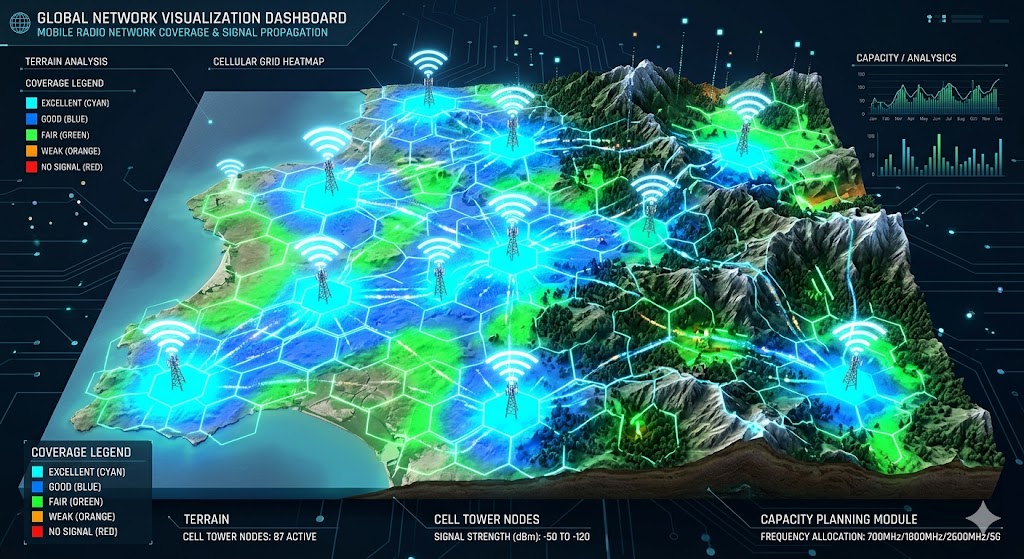
RF simulation is performed by RF engineers using professional RF simulation software. The quality of simulation results depends on the precision and accuracy of the nationwide digital map of Myanmar for simulation, the accuracy of latitude and longitude data of existing MPT sites, as well as the practical experience of RF engineers.
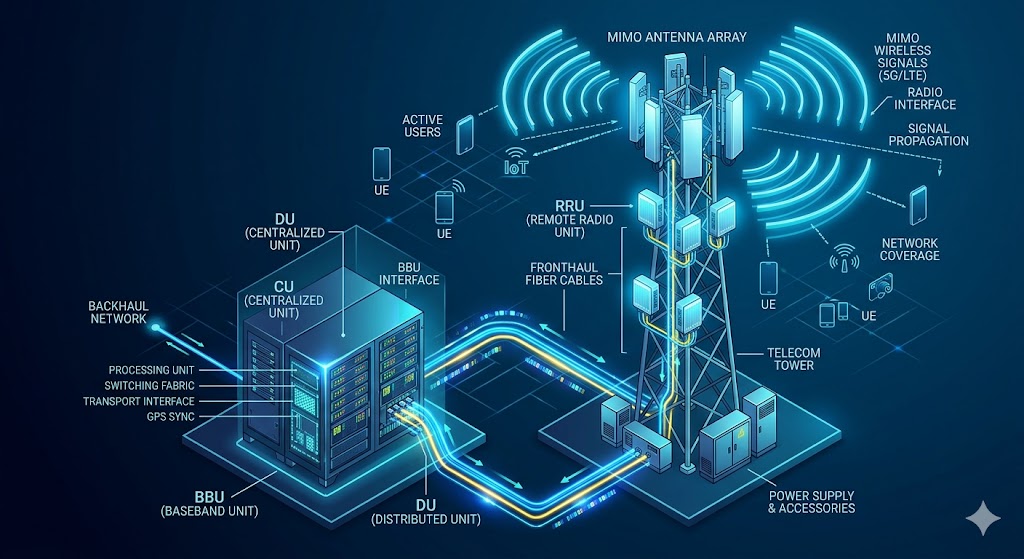
As mentioned earlier, Telenor Myanmar follows the network deployment principle of prioritizing leasing over new construction, minimizing self-built facilities and centralizing equipment deployment whenever possible. Therefore, the radio site locations generated by RF simulation are designed to overlap with existing MPT sites to facilitate direct leasing of MPT's site resources. Meanwhile, RF engineers shall reduce the total number of radio sites as much as possible while meeting coverage requirements, so as to cut down the construction cost of the RAN at the source.
Deliverables of RAN RF simulation are as follows:
Equipment-side RAN planning is completed by radio engineers, who make fine adjustments to Company H’s standard 4G RAN solution in accordance with Telenor Myanmar’s technical specifications.
In the 2G and 3G eras, the RAN was composed of base stations and base station controllers. In the 4G era, base station controllers were eliminated, leaving only base stations. This greatly simplified the overall network architecture. In addition, 4G base stations adopt full-IP interconnection with the bearer network, which also simplifies physical interface deployment.
Deliverables of equipment-side RAN planning are as follows:
Site Type for Each Location
Base stations are categorized into four types: Macro Site, Micro Site, Pico Site and Femto Site. These types differ significantly in coverage range, construction cost, power supply mode, radiation level and service functions. Appropriate base station types shall be selected for each site based on RF simulation results and construction budget.
Equipment Selection for Each Location
Equipment selection is determined according to site type, capacity requirements, reliability requirements, security protection requirements and future expansion potential.
Access and Bearing Requirements for Each Site
This includes the interface type for interconnection with the bearer network, interconnection schemes, as well as requirements on bandwidth, QoS, latency, packet loss rate and jitter.
RAN planning report (covering all seven dimensions of network planning)
By Lanaotek
Lanaotek specializes in translating cutting-edge optical and Ethernet transmission technologies into clear, valuable insights that help our customers stay ahead in a fast-evolving digital world.
By turning complex technical concepts into practical, business-driven content, we aim to empower decision-makers with the knowledge they need to make confident, future-ready choices.
 EN
EN
 fr
fr  es
es  ru
ru  pt
pt  ar
ar  de
de 
 Internet Data Center
 FAQs
FAQs Industry News
 About Us
 Data Center Switch
  Enterprise Switch
  Industrial Switch
  Access Switch
  Integrated Network
  Optical Module & Cable




 Call us on:
  Email Us:
  2106B, #3D, Cloud Park Phase 1, Bantian, Longgang, Shenzhen, 518129, P.R.C.