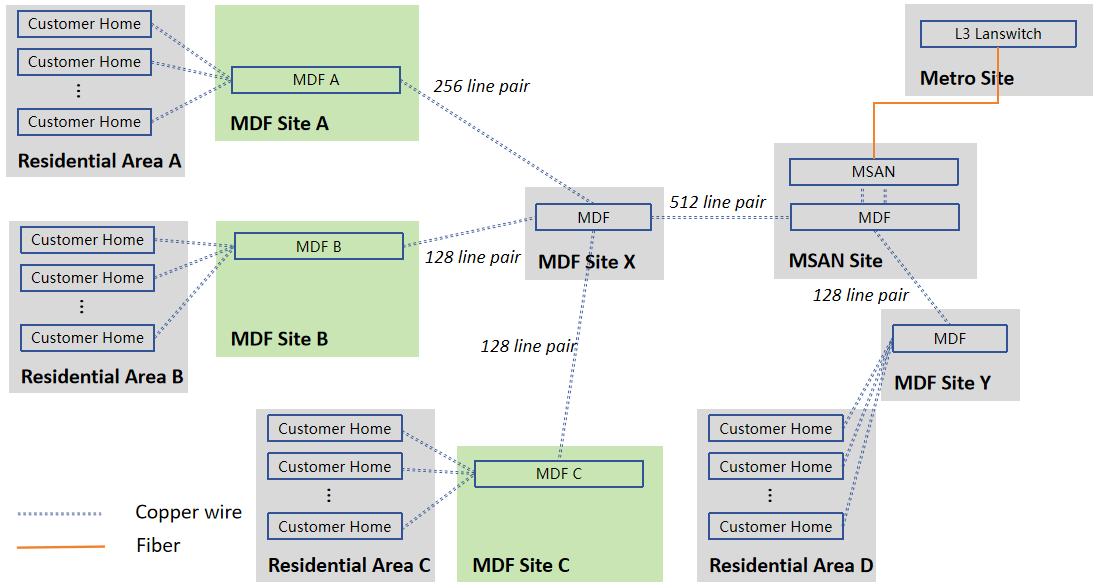
Vivacom Bulgaria’s FBB Access Network adopts the xDSL Modem + MSAN networking architecture. Twisted-pair copper cables run from the MSAN to xDSL Modems at end subscribers’ premises. The twisted-pair copper cables routed out of the MSAN site are split to residential areas in different directions via two or more layers of Main Distribution Frames (MDFs). For example, a 512-pair twisted-pair cable runs from the MSAN site to a junction point serving three residential districts to the west of the MSAN site, where an MDF Site X is built. From MDF Site X, separate twisted-pair cables branch off to each of the three residential areas. Districts with more subscribers are allocated cables with more line pairs, while districts with fewer subscribers get cables with fewer line pairs, as shown in the figure below:
Site selection for FBB access remote drop sites is carried out along the routing of twisted-pair copper cables originating from MSAN sites, with candidate locations selected from existing MDF sites. The copper cable length from the selected MDF site to end subscribers must be shorter than the maximum transmission distance supported by VDSL Vectoring technology: a bandwidth of 100 Mbps is available within 300 meters, and 80 Mbps within 500 meters. Residential areas whose distance from the MSAN site is within the supported transmission range of VDSL Vectoring do not require new remote drop sites; the new MSAN equipment will deliver VDSL Vectoring broadband services directly. As shown in the figure below:
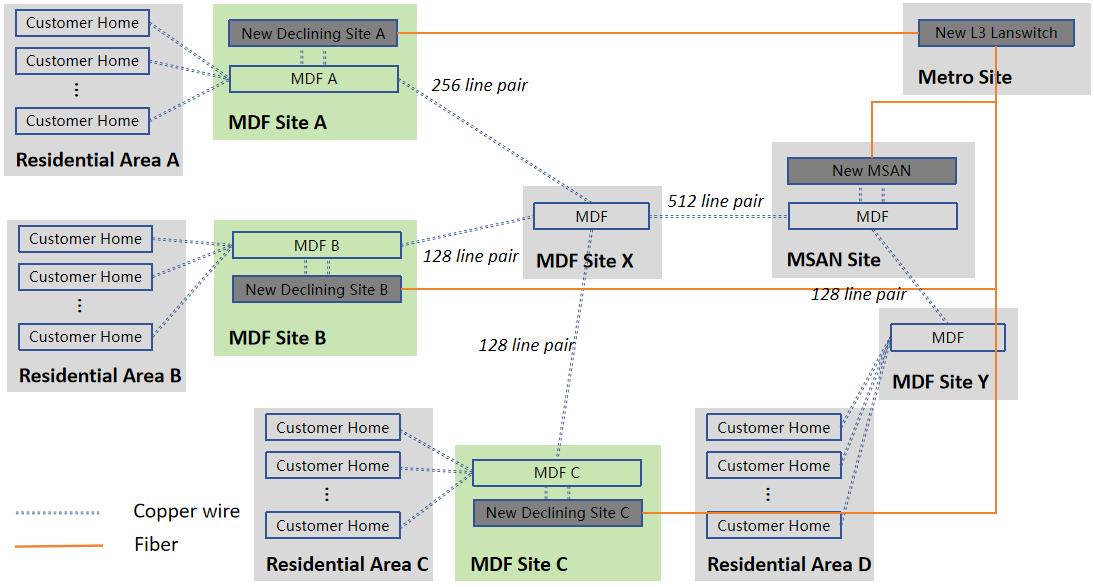
After remote drop sites are finalized, the quantities of Combo boards and Voice boards for VDSL equipment at each drop site are determined based on the number of voice-only subscribers, broadband-only subscribers, and dual-service (voice + broadband) subscribers covered by the site. The model of VDSL equipment and cabinet type are then confirmed according to the board quantities.
Only one model of VDSL equipment is selected through the above process: the MA5616, which supports a maximum of 128 VDSL Vectoring lines and 128 voice lines. Two types of outdoor cabinets are specified:
1. S100 outdoor cabinet: accommodates one set of VDSL equipment plus matching MDF modules
2. S200 outdoor cabinet: accommodates two sets of VDSL equipment plus matching MDF modules
VDSL equipment inside outdoor cabinets adopts PSTN Local Loop Powering. The standard effective transmission distance of this power supply technology is 5 km; by adopting supplementary technical measures such as boosted supply voltage, the power delivery distance can be extended to 7–10 km. Power supply units for PSTN Local Loop Powering are deployed at MSAN sites, while three power receiving modules for PSTN Local Loop Powering are installed inside the outdoor cabinet of each remote drop site. Twenty-four twisted pairs (3 × 8 = 24) within the copper cables running from the MSAN site to the remote drop site deliver sufficient power to the VDSL equipment housed in the outdoor cabinet. This solution eliminates the costs and construction cycle associated with introducing mains electricity, UPS and backup batteries at remote drop sites.
Once remote drop site locations, VDSL equipment models and cabinet types are confirmed, on-site surveys and detailed design work are conducted at each selected drop site. The scope includes determining the construction position of the concrete base for the outdoor cabinet, as well as the routing of twisted-pair copper cables connecting the concrete base to the local MDF at the site.
After the survey and design deliverables are reviewed and approved by Vivacom, construction work commences, including pouring concrete bases for outdoor cabinets, laying twisted-pair copper cables between the concrete bases and local MDF cabinets, and deploying fiber optic cables for the uplink from VDSL equipment at remote drop sites to MAN sites.
By Lanaotek
Lanaotek specializes in translating cutting-edge optical and Ethernet transmission technologies into clear, valuable insights that help our customers stay ahead in a fast-evolving digital world.
By turning complex technical concepts into practical, business-driven content, we aim to empower decision-makers with the knowledge they need to make confident, future-ready choices.
 EN
EN
 fr
fr  es
es  ru
ru  pt
pt  ar
ar  de
de 
 Internet Data Center
 FAQs
FAQs Industry News
 About Us
 Data Center Switch
  Enterprise Switch
  Industrial Switch
  Access Switch
  Integrated Network
  Optical Module & Cable

 Call us on:
  Email Us:
  2106B, #3D, Cloud Park Phase 1, Bantian, Longgang, Shenzhen, 518129, P.R.C.