Industrial Ethernet switch selection often starts with a simple question: how many devices need to be connected?
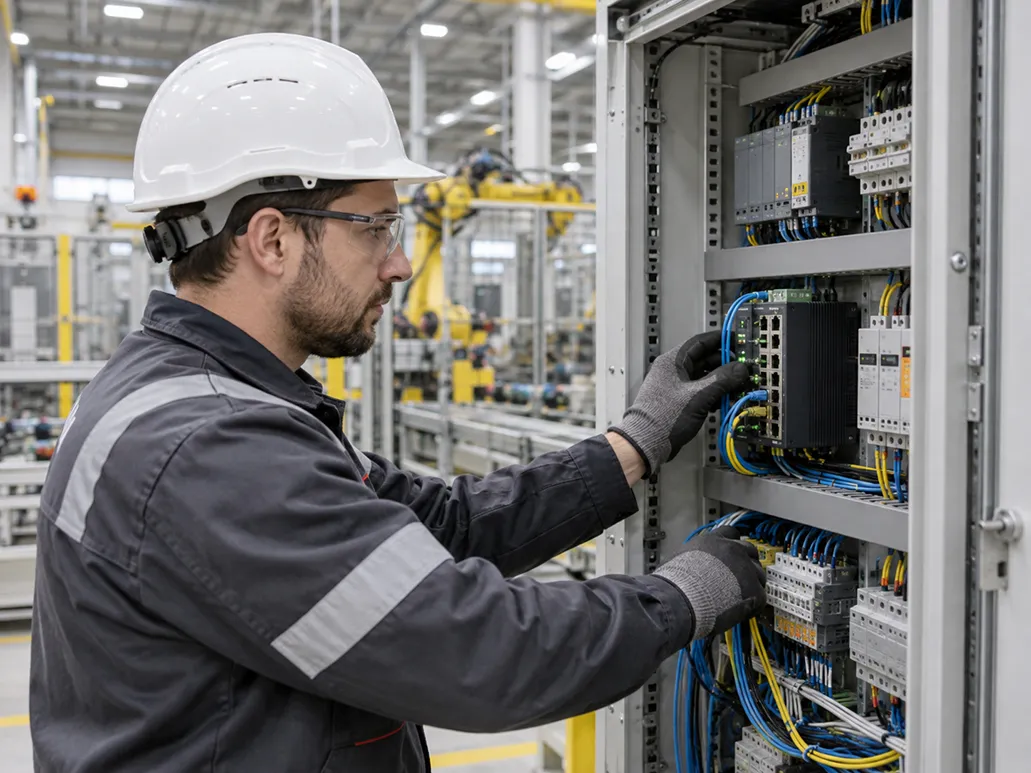
In real projects, that question is only the beginning. A production line, traffic monitoring site, energy facility, warehouse, or outdoor security network may involve IP cameras, PLCs, wireless bridges, sensors, gateways, NVRs, local control cabinets, and long-distance fiber links. Some devices require Power over Ethernet. Some sites need ring protection. Some cabinets face heat, dust, ethernet switch manufacturers,surge exposure, unstable power, or limited maintenance access.
For system integrators, security project companies, network distributors, and OEM/ODM partners, the risk is not only buying the wrong switch. The larger risk is deploying equipment that looks correct on paper but fails during sample testing, site acceptance, or long-term operation.
This article explains six practical challenges in industrial switch deployment and the questions engineers and procurement teams should confirm before selecting a model.
Port Count Is Not the Same as Network Fit
Many industrial network designs begin by counting connected devices. If there are four devices, a four-port switch appears sufficient. If the project grows to eight or sixteen devices, a larger model seems like the next step.
That approach can miss the real architecture.
Industrial projects usually require a mix of access ports, uplink ports, copper ports, fiber ports, PoE ports, and management functions. A switch may have enough physical ports but still be unsuitable if it lacks the right uplink type, PoE capability, redundancy feature, or management function.
Before choosing a model, confirm:
How many endpoint devices need copper Ethernet access.
Whether each endpoint requires PoE or only data.
Whether uplinks should use RJ45 copper, SFP fiber, or higher-speed optical links.
Whether the site requires VLAN, QoS, SNMP, ERPS, port mirroring, 802.1X, or other managed features.
Whether the network will add cameras, sensors, APs, or industrial controllers later.
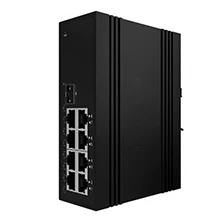
For example, the Lanaotek IDSL2M-02S04G-L is positioned as a compact DIN-rail managed industrial switch with four Gigabit RJ45 ports and two SFP fiber ports. It may fit small industrial networks that need local copper access and fiber uplinks.
For similar networks that require PoE at the edge, the IDSL2M-02S04GP-L adds four Gigabit PoE+ ports and two SFP fiber ports. The difference is not only "PoE or non-PoE." It changes the power input, PoE budget, device load planning, and acceptance test scope.
The practical lesson is simple: start from topology, not from port count.
PoE Planning Requires Both Per-Port Power and Total Budget
PoE is common in industrial security and outdoor monitoring projects because one Ethernet cable can carry data and power to compatible devices such as IP cameras, wireless bridges, access control devices, and some IoT endpoints.
However, a switch with PoE ports cannot automatically power every connected device in every condition.
Engineers need to confirm two different limits:
| PoE item | What it means | Why it matters |
|---|
| Per-port PoE power | The maximum power one port can provide to one device | A PTZ camera, infrared camera, or wireless bridge may exceed the capacity of a low-power PoE port |
| Total PoE power budget | The total power the switch can allocate across all PoE ports | A switch may have enough PoE ports but not enough total budget to power all devices at peak load |
The Lanaotek IDSL2M-02S04GP-L product page lists IEEE 802.3af/at support, up to 30 W per PoE+ port, and a PoE power budget of up to 120 W. These values are useful for evaluating compact industrial PoE deployments, but the project still needs a real load calculation.
The calculation should include:
Maximum power consumption of each powered device.
Infrared night mode or heater load for cameras.
Startup current and power negotiation behavior.
Cable length and cable quality.
Power supply capacity and input-voltage design.
Future device expansion.
For important projects, PoE planning should be verified during sample testing with the actual camera, wireless bridge, cable, power supply, and switch configuration intended for deployment.
Copper and Fiber Uplinks Must Match the Real Site
Copper Ethernet is simple and cost-effective for short links inside a cabinet, room, or nearby installation area. As the network extends across production zones, buildings, outdoor cabinets, or electrically noisy locations, fiber becomes more important.
Fiber uplinks can help with:
Longer-distance connections.
Electrical isolation between areas.
Reduced exposure to electromagnetic interference.
Aggregation from distributed access switches to a control room or core network.
Higher bandwidth where many edge devices send traffic upstream.
Still, an SFP slot does not guarantee that every optical module or cable will work correctly.
Before deployment, confirm:
Link distance.
Single-mode or multimode fiber.
Connector type.
Wavelength.
Data rate.
SFP coding and switch compatibility.
Required operating temperature for the optical module.
Uplink bandwidth after camera, sensor, or machine traffic is aggregated.
This is one of the most common places where procurement and engineering teams can talk past each other. The procurement request may say "2 SFP ports," while the installation team actually needs a specific fiber type, module speed, distance, and environmental grade.
For a reliable recommendation, provide the switch model, fiber type, link distance, optical module requirements, and expected traffic load together.
Redundancy Is a System Design, Not a Checkbox
Industrial networks often support production, monitoring, automation, transportation, energy, or security operations. In these cases, a single link failure may affect more than one device.
Ring protection is one way to improve resilience. Ethernet Ring Protection Switching, also known as ERPS and standardized by ITU-T G.8032, is commonly used in ring-based Ethernet designs. The goal is to restore traffic through an alternate path when a ring link fails.
The Lanaotek IDSL2M-02S04G-L and IDSL2M-02S04GP-L product pages list support for G.8032 ERPS, with recovery time stated as less than or equal to 20 ms under specified conditions.
That specification is valuable, but it should not be treated as a complete resilience plan.
Actual recovery behavior depends on:
Network topology.
Switch configuration.
Number of switches in the ring.
Interoperability between devices.
Failure type and failure location.
Power supply design.
Upstream routing or aggregation design.
Whether endpoints can tolerate brief link changes.
Before mass deployment, engineers should test link failure, power interruption, reboot recovery, alarm behavior, and management visibility. A project that requires redundancy should define what failure scenarios must be recovered, how quickly recovery must occur, and how the maintenance team will confirm that the network is healthy after recovery.
The Installation Environment Can Change the Equipment Decision
An Ethernet switch that works in an office may not be suitable for an industrial cabinet or outdoor edge site.
Industrial installations may involve:
High or low temperature.
Poor ventilation inside cabinets.
Dust, vibration, or electrical noise.
Surge exposure and grounding issues.
Unstable DC power.
Limited installation space.
Condensation, water exposure, or corrosive environments.
The IDSL2M-02S04GP-L product page lists DIN-rail installation, fanless IP40 housing, 44-57 VDC redundant power input, 4 kV surge protection, ESD protection, and an operating temperature range of -40 degrees C to +75 degrees C.
These are useful industrial specifications, but they still need to be matched to the site. IP40 should not be interpreted as waterproof protection. A wide operating temperature range does not automatically solve direct sunlight, sealed-cabinet heat buildup, condensation, coastal corrosion, or lightning exposure.
For outdoor or harsh environments, the switch selection should be evaluated together with:
Cabinet or enclosure protection.
Heat dissipation.
Cable entry and waterproofing.
Grounding and surge protection.
Power supply design.
Maintenance access.
Local safety and certification requirements.
The correct decision depends on the whole installation, not only the switch label.
Managed Features Only Create Value When They Match Operations
Managed industrial switches can provide VLAN, QoS, SNMP, port mirroring, 802.1X, ERPS, LLDP, IGMP snooping, PoE management, logs, and other functions, depending on the model.
These functions can improve visibility and control, but only when the project has a clear operational need.
For example:
VLAN can separate camera, automation, office, and maintenance traffic.
QoS can prioritize selected traffic when the network is congested.
SNMP can help monitoring systems collect device status.
Port mirroring can support troubleshooting and packet analysis.
802.1X can support access-control designs where the full network policy is prepared.
PoE management can help maintain powered devices more efficiently.
The mistake is buying managed features without a maintenance plan, or choosing an unmanaged switch for a network that will later require segmentation, monitoring, and troubleshooting.
Before choosing between unmanaged, web smart, L2 managed, L2+ managed, or L3 industrial switches, confirm:
Who will configure the switch.
What network segmentation is required.
Whether remote monitoring is needed.
Whether field teams can collect logs and configuration files.
Whether the customer expects firmware, configuration, or troubleshooting support.
Whether the project has acceptance criteria for VLAN, redundancy, PoE, or management functions.
For B2B projects, the switch is not only a hardware item. It is part of the customer's maintenance workflow.
Practical Industrial Switch Procurement Checklist
Use this checklist before requesting a quotation or sample.
| Evaluation area | Questions to confirm |
|---|
| Application scenario | Is the project for factory automation, IP surveillance, transportation, energy, outdoor monitoring, smart city, warehouse, or another industrial site? |
| Connected devices | What devices will connect to the switch: PLC, SCADA, IP camera, NVR, wireless bridge, AP, gateway, sensor, router, or server? |
| Port configuration | How many RJ45 ports, PoE ports, and SFP ports are required? |
| Port speed | Are Fast Ethernet, Gigabit, 2.5G, 10G, or other uplink speeds needed? |
| PoE load | Which devices require PoE, what is the peak power per device, and what is the total power budget? |
| Fiber link | What fiber type, distance, wavelength, connector, and optical module compatibility are required? |
| Redundancy | Is ERPS, STP, RSTP, dual power input, or another protection mechanism required? |
| Management | Are VLAN, QoS, SNMP, port mirroring, 802.1X, LLDP, IGMP, logs, or PoE management required? |
| Environment | What are the temperature, cabinet, grounding, surge, dust, humidity, and enclosure conditions? |
| Certification | Which certificates or compliance documents are needed for the target country or project owner? |
| Sample test | What must be tested before bulk deployment: PoE load, fiber link, VLAN, redundancy, firmware, environmental condition, or third-party device compatibility? |
| Project schedule | Is the project tied to a tender, site acceptance date, customer payment milestone, or urgent replacement? |
Completing this checklist makes it easier for the supplier to recommend the right configuration and reduces the risk of choosing a model that cannot pass the real project test.
What to Send When Asking for a Recommendation
For faster model selection, send the following information with your inquiry:
Network topology or simple diagram.
Device list and quantity.
Required port count and speed.
PoE device power requirements.
Fiber distance and optical module requirements.
Installation environment and cabinet conditions.
Required managed features.
Target country and certification requirements.
Estimated quantity and sample plan.
Required delivery timeline.
Any existing device models that must be compatible.
If the project involves branding, local distribution, or product-line development, also state whether you need standard products, OEM branding, ODM customization, SKD cooperation, special firmware, packaging, certification support, or project-specific documentation.
Conclusion: Select the Switch Around the Project, Not Only the Datasheet
Industrial Ethernet switch selection is not only a comparison of port count, unit price, or one headline specification.
A reliable decision should connect the switch to the project: topology, PoE load, fiber distance, redundancy, environment, management workflow, certification, sample testing, delivery schedule, and after-sales responsibility.
Lanaotek provides industrial switching, PoE switching, optical connectivity, enterprise networking, data center switching, and integrated network products for global B2B customers. For industrial and security projects, Lanaotek can support model selection and requirement review based on the customer's application, network topology, connected devices, environmental conditions, and project constraints.
Looking for an industrial Ethernet switch for your next project?
Share your port configuration, PoE power budget, fiber link requirements, operating environment, redundancy needs, certification requirements, and expected quantity. A clearer project input leads to a more accurate recommendation, fewer sample-test surprises, and a more reliable deployment.
By Lanaotek
Lanaotek specializes in translating cutting-edge optical and Ethernet transmission technologies into clear, valuable insights that help our customers stay ahead in a fast-evolving digital world.
By turning complex technical concepts into practical, business-driven content, we aim to empower decision-makers with the knowledge they need to make confident, future-ready choices.
 EN
 fr
 es
 ru
 pt
 ar
 de

 Internet Data Center
 FAQs
 Industry News
 About Us
 Data Center Switch
 Enterprise Switch
 Industrial Switch
 Access Switch
 Integrated Network
 Optical Module & Cable



 Call us on:
 Email Us:
 2106B, #3D, Cloud Park Phase 1, Bantian, Longgang, Shenzhen, 518129, P.R.C.
